Azure AI Solutions Architecture
The AI Architect Transformation
Note: Learning objectives above use imperative form (Trace, Contrast, Apply) to state intended outcomes. Body exposition uses third-person narrative to describe architectural concepts and patterns.
The role of the Azure architect has never been static. Each wave of infrastructure evolution demanded that architects unlearn deeply held assumptions and rebuild their mental models from first principles. The emergence of AI-native systems represents the most profound inflection point yet: one that does not merely extend the cloud architect's toolkit but fundamentally challenges the deterministic reasoning patterns that made cloud architects effective in the first place.
The Architecture Evolution: Six Epochs of Thinking
From Iron to Instances: Infrastructure and Virtualization
The infrastructure engineer's world was defined by physical constraints — rack units, power draw, named servers such as sqlprod01.corp.contoso.com, and six-month capacity planning exercises. Resilience came from redundant hardware: dual power supplies, RAID arrays, hot standby nodes, and change advisory boards.
Virtualization eroded the one-to-one relationship between hardware and workload. VMware vSphere, Hyper-V, and public cloud hypervisors abstracted the physical layer, shifting the mental model from "servers" to "capacity pools." The skills that defined excellence here — capacity planning, blast-radius analysis, dependency mapping — remain relevant but were optimized for fully deterministic systems.
Cloud Architecture: Elasticity, Services, and Well-Architected
Azure and the hyperscaler clouds introduced managed primitives — VMs, databases, blob storage, Virtual Networks (VNets), Network Security Groups (NSGs) — codified by the Well-Architected Framework across Reliability, Security, Cost Optimization, Operational Excellence, and Performance Efficiency. Architects mastered Infrastructure as Code (IaC) via ARM, Bicep, and Terraform, shared responsibility models, landing zone design, and hub-and-spoke topologies.
The key insight of the cloud era was that architecture is code: repeatable, version-controlled, testable, and deployable through pipelines. This insight carries forward into the AI era with even greater urgency, because AI systems compound the complexity of cloud systems rather than replacing them.
Cloud-Native Architecture: Microservices and Declarative Systems
Cloud-native architecture decomposed monoliths into independently deployable services over well-defined APIs. Azure Kubernetes Service (AKS) and Azure Container Apps provided managed control planes; Flux and ArgoCD enabled GitOps workflows. The cloud-native architect developed distributed systems reasoning: CAP theorem trade-offs, saga patterns, circuit breakers, and observability through logs, metrics, and traces.
Cloud-native architecture also introduced the control plane / data plane separation central to AI systems design. Azure AI services follow the same pattern: the control plane manages model deployment and configuration, while the data plane handles inference requests — with distinct availability, latency, and security properties.
Data-Driven Architecture: Pipelines, Lakehouses, and Streaming
The data-driven era built platforms for ingesting, storing, processing, and serving data at scale — Azure Data Factory, Synapse Analytics, Databricks, Event Hubs, and Microsoft Purview for governance. Architects mastered medallion architecture (bronze/silver/gold), Lambda and Kappa streaming, and GDPR-era data lineage requirements.
This era planted two seeds for AI architecture: output quality is bounded by input data quality, and streaming pipelines introduced probabilistic SLAs — a 99.97% event-processing rate managed through dead-letter queues, not perfection. AI systems extend this probabilistic reasoning from data pipelines into the core business logic itself.
AI-Enabled Architecture: Embedding Models into Existing Systems
From roughly 2019 through 2024, organizations integrated pre-trained models into otherwise traditional architectures as point solutions — fraud detection, image classification, recommendation ranking. Each was a model endpoint called via HTTP, its output consumed like any other API response. The surrounding architecture remained deterministic; if the endpoint failed, the fallback was a rule-based heuristic.
The AI-enabled phase taught architects that models are not static artifacts. Unlike a compiled binary, a model's effective behavior changes as the world changes. Temporal concerns — training data cutoffs, concept drift, retraining cadence — became first-class architectural concerns with no precedent in traditional cloud architecture.
AI-Native Architecture: Probabilistic Systems as First-Class Citizens
AI-native architecture emerges when the intelligent, probabilistic component is the system's organizing logic — an LLM orchestrating multi-step reasoning, deciding which tools to invoke, interpreting ambiguous intent, and generating free-form output that downstream components must parse. The system's behavior is no longer fully specifiable; it is emergent, shaped by model capabilities, prompt design, grounding data, safety constraints, and the statistical properties of the input distribution.
The architect's job shifts from designing deterministic state machines to designing probabilistic systems with reliable aggregate behavior. Achieving this requires patterns — structured output enforcement, semantic caching, retrieval augmentation, evaluation pipelines, content safety gates — that have no direct analog in traditional cloud architecture. The Azure AI platform (Azure OpenAI Service, AI Foundry, AI Search, Content Safety, Azure ML) provides the building blocks.
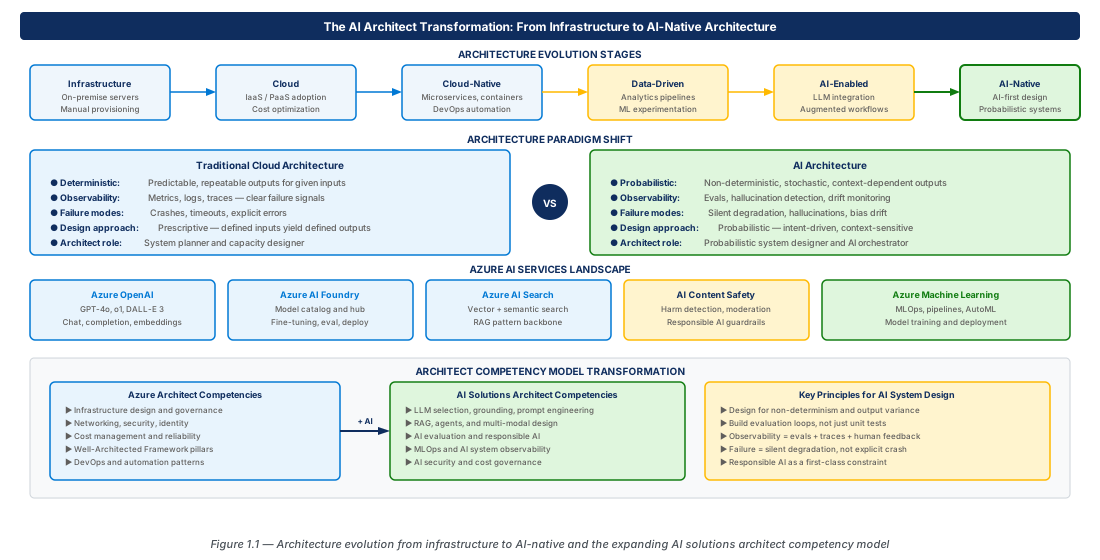
Traditional Cloud Architecture vs. AI Architecture
Determinism and Predictability
Traditional cloud architecture is built on determinism: an Azure Function given the same inputs and the same downstream state produces the same output every time. This determinism is the philosophical basis for IaC, idempotent deployments, and software testing as currently practiced.
AI systems built on LLMs are inherently non-deterministic at the token level. Even at temperature=0, subtle differences in context window state and floating-point arithmetic can produce variation. The architectural response is not to eliminate non-determinism but to contain it: structured output schemas (JSON mode, function calling), evaluation pipelines measuring quality distributions, and semantic caching for common queries.
Important
Never design an AI-native system that relies on exact-match comparison of LLM outputs for correctness verification. Design evaluation pipelines that measure semantic correctness, factual accuracy, and safety compliance rather than string equality.
Observability and Failure Modes
Cloud systems fail in well-documented ways — VM health probes fail, connection pools exhaust, circuit breakers trip — with known shapes, remediation steps, and alerting thresholds. AI systems introduce failure modes with no analog: hallucination silently corrupts outputs without raising an exception, requiring secondary LLM judges or RAG patterns that ground outputs in verified source documents.
Prompt injection — adversarial content in the context window that instructs the model to behave contrary to its system prompt — is an AI-specific security failure mode. An agent processing untrusted documents is vulnerable: a malicious document might cause data exfiltration, unintended tool invocations, or safety control bypass. Traditional WAFs and input validation do not address this threat.
Warning
Do not assume Azure OpenAI's content filtering provides complete protection against prompt injection attacks targeting AI agents. Content Safety filters detect harmful output categories but are not designed to prevent an agent from following instructions embedded in a malicious document. Treat untrusted input documents as potentially adversarial.
Latency, Cost, and Resource Models
LLM inference economics are token-linear: you pay per input token and per output token regardless of computational complexity. This creates perverse incentives — architects applying cloud cost instincts (smaller instances, less I/O) may optimize the wrong dimensions while prompt length and output verbosity, the dominant cost drivers, go unmanaged.
Latency is dominated by time-to-first-token (TTFT), which scales with prompt length and model size. Streaming responses — beginning output delivery as tokens are generated — are the standard mitigation and require clients that handle incremental streaming, with UX patterns that make streaming feel natural.
Tip
Provision dedicated throughput (PTUs) in Azure OpenAI Service for production workloads with predictable, high-volume traffic. PTUs provide guaranteed TTFT and throughput at predictable monthly cost, insulating production workloads from latency variability and throttling of shared consumption-tier deployments.
| Azure OpenAI Tier | Billing Model | Latency Guarantee | Throttling Behavior | Best For |
|---|---|---|---|---|
| Consumption (Pay-as-you-go) | Per token | None | 429 on quota exceeded | Dev/test, low volume, bursty |
| Provisioned (PTUs) | Monthly reservation | Guaranteed TTFT/TPS | Graceful degradation within PTU | Production, high-volume, latency-sensitive |
| Standard (batch) | Per token, discounted | Async (24hr window) | Queue-based | Offline processing, document batches |
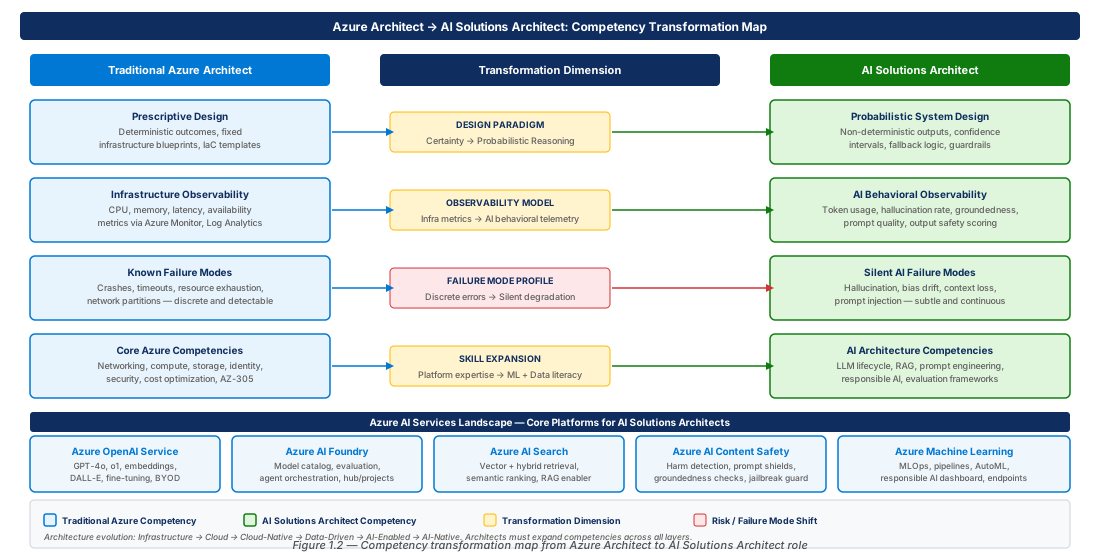
From Prescriptive Design to Probabilistic System Design
The Prescriptive Architecture Paradigm
Prescriptive architecture begins with requirements and produces a design that fully specifies system behavior: components, interactions, and constraints captured in architecture diagrams, ADRs, and IaC. The system is a machine — it either works as designed or is broken — and troubleshooting means comparing observed behavior to specified behavior.
This paradigm fails for AI systems because their requirements are partially statistical. "The system shall answer customer support questions accurately" is not a fully specifiable requirement: accuracy is a distribution, not a binary state; the definition may shift; and the capability ceiling is set by the model, which the architect does not control and which changes with each model update.
Probabilistic System Design
Probabilistic system design accepts stochastic component behavior and designs the overall system to meet aggregate quality targets despite that stochasticity. The shift is from "this system shall always produce the correct output" to "this system shall produce outputs meeting defined quality criteria with probability P over input distribution D, measured by evaluation method M."
The architect must specify not only components and interactions but also the evaluation methodology, quality thresholds, monitoring strategy, and feedback loop connecting production observations to model improvement. These are not afterthoughts; they are first-class architectural concerns designed before the system is built.
Note
Azure AI Foundry provides native evaluation capabilities including automated evaluators for groundedness, relevance, coherence, fluency, and safety. Integrate AI Foundry evaluations into CI/CD pipelines to gate deployments on quality thresholds, not just functional test passage.
The Architect as System Ecologist
The most useful mental model for the AI-native architect is not the machine builder but the ecologist. A machine builder specifies every component completely; an ecologist designs conditions — environments, constraints, incentive structures — that shape the behavior of agents that cannot be fully controlled or predicted.
This shift requires designing the environment in which AI components operate: grounding data quality, system prompt precision, Content Safety guardrails, tool definitions for agentic systems, and the evaluation framework. The model behaves probabilistically within this designed environment, and the system achieves quality targets through the aggregate effect of environmental constraints. New skills, tools, and vocabulary are required — but the cloud architect's foundation is extended, not replaced.
Azure Architect vs. AI Solutions Architect: The Competency Delta
The Azure Architect Competency Model
The Azure Architect (AZ-305) demonstrates competency across five domains: identity and governance (Entra ID, Role-Based Access Control (RBAC), Azure Policy, Management Group hierarchies); compute, networking, and storage (VMs, AKS, App Service, VNets, Storage Accounts); data and application architecture (Azure SQL, Cosmos DB, Service Bus, Event Grid); monitoring and optimization (Azure Monitor, Log Analytics, Cost Management); and security (network security, identity, data protection, Azure Security Benchmark).
This foundation is necessary for AI systems architecture because AI systems are cloud systems: they run on Azure compute, are secured by Azure identity controls, are monitored by Azure Monitor, and are governed by Azure Policy. An AI solutions architect who lacks this foundation will struggle with the operational and security dimensions of AI systems.
The AI Solutions Architect Competency Extension
The AI Solutions Architect extends the Azure Architect model with five additional domains. The table below maps each competency area, indicating whether it extends an existing cloud architecture competency or is a net-new capability requirement.
| Competency Domain | Azure Architect | AI Solutions Architect | Delta Type |
|---|---|---|---|
| Identity & Governance | Entra ID, Role-Based Access Control (RBAC), Policy | + Managed Identity for AI services, AI content policies, data residency | Extension |
| Compute & Networking | VMs, AKS, Virtual Networks (VNets), Network Security Groups (NSGs) | + Private endpoints for Azure OpenAI, VNet integration for AI Foundry, GPU SKU selection | Extension |
| Data Architecture | SQL, Cosmos DB, ADLS | + Vector databases (AI Search), embedding pipelines, RAG data architecture | Extension |
| Monitoring & Ops | Azure Monitor, Log Analytics | + LLM observability (token usage, latency, quality scores), model drift detection | Extension |
| Security | Zero Trust, WAF, DDoS | + Prompt injection defense, jailbreak detection, Content Safety integration, AI red-teaming | Net-new |
| AI Service Architecture | Not applicable | Azure OpenAI deployment patterns, AI Foundry project design, model selection | Net-new |
| Prompt Engineering | Not applicable | System prompt design, RAG prompt patterns, structured output schemas, few-shot examples | Net-new |
| Evaluation & Quality | Functional testing, SLAs | AI evaluation methodology, quality metrics, red-teaming, continuous evaluation in production | Net-new |
| Agent Architecture | Not applicable | Tool design, agent orchestration (Semantic Kernel, LangChain), multi-agent coordination | Net-new |
| Responsible AI | Not applicable | Fairness, transparency, accountability, Microsoft RAI Standard, Content Safety policy design | Net-new |
Building the Bridge: A Practical Learning Path
The recommended approach is to begin with a scoped, low-risk AI use case — internal knowledge base Q&A, document summarization, code generation for developers — and deliberately instrument it as a learning platform. Deploy Azure OpenAI Service with private endpoints, build a basic RAG pipeline against Azure AI Search, and instrument the system with Azure Monitor and AI Foundry evaluation to build observability and quality measurement competencies.
Tip
Use Azure AI Foundry's Prompt Flow as your first AI orchestration environment, even if you later adopt Semantic Kernel or LangChain for production. Prompt Flow's visual, observable execution graph makes the prompt engineering and evaluation learning curves shorter, and the operational concepts translate directly to production frameworks.
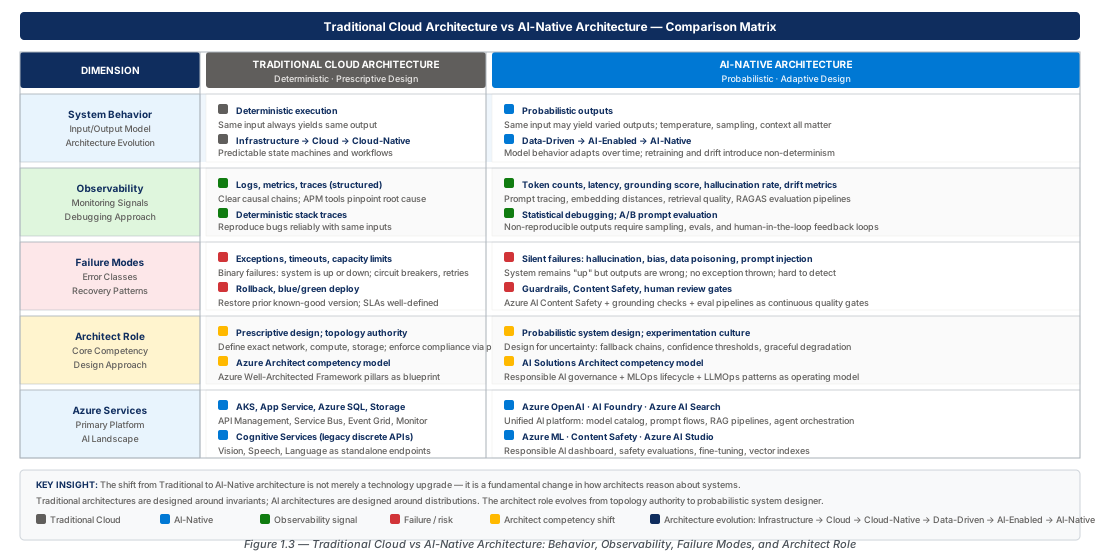
Azure AI Services Landscape
Azure OpenAI Service
Azure OpenAI Service provides enterprise-grade access to OpenAI foundation models (GPT-4o, GPT-4, GPT-3.5-Turbo, Ada embeddings, DALL-E, Whisper) within the Azure security and compliance boundary. Key enterprise differentiators over direct OpenAI API access: private endpoint support, Entra ID authentication, data residency guarantees, integrated Content Safety, and enterprise SLAs.
Deployment is organized into Azure OpenAI Resources (control plane) and Model Deployments (data plane). A single resource can host multiple deployments, enabling different models for different tasks — GPT-4o for complex reasoning, GPT-3.5-Turbo for high-volume simple tasks, Ada-002 for embeddings — while sharing a single identity and networking boundary.
Azure AI Foundry
Azure AI Foundry (formerly Azure ML + Azure AI Studio, unified in 2024) is the enterprise platform for building, evaluating, deploying, and monitoring AI applications. An AI Foundry Hub provides shared infrastructure — compute clusters, private network configuration, connected Azure OpenAI and AI Search resources — while an AI Foundry Project provides team-level access controls, prompt flow definitions, evaluation datasets, and deployment endpoints.
Prompt Flow, the embedded orchestration engine, defines complex AI workflows — multi-step LLM chains, retrieval operations, tool invocations, conditional logic — as DAGs with built-in tracing, evaluation, and deployment tooling. The AI Foundry Model Catalog provides access to foundation models beyond GPT (Meta Llama, Mistral, Cohere) within the same security and operational boundary.
Azure AI Search
Azure AI Search (formerly Cognitive Search) serves three distinct functions in AI architectures: semantic search (neural re-ranking for improved relevance), vector search (approximate nearest neighbor over dense embeddings), and hybrid search (BM25 + vector with Reciprocal Rank Fusion — typically the highest-quality retrieval strategy for RAG workloads).
The standard RAG integration: documents are chunked, embedded (Ada-002 or text-embedding-3), and indexed with both full-text and vector fields. At query time, the user's question is embedded, top-K chunks retrieved semantically, and those chunks injected into the LLM's context window as grounding — dramatically reducing hallucination rates for factual Q&A and providing source citations for auditability.
Note
Azure AI Search's integrated vectorization feature (preview as of early 2026) enables automatic chunking and embedding during indexing, eliminating a separate embedding pipeline. Evaluate integrated vectorization for new projects before building a custom pipeline; use custom pipelines only when specific chunking strategies or custom embedding models are required.
Azure AI Content Safety
Azure AI Content Safety detects and mitigates harmful content across four harm categories (hate speech, sexual content, violence, self-harm) at four severity levels, plus prompt shield capabilities (detecting prompt injection and jailbreak attempts), groundedness detection (identifying hallucinated claims), and protected material detection (identifying copyrighted content).
Architectural placement is a critical design decision. Input filtering prevents clearly harmful requests from consuming inference quota; output filtering catches harmful content that bypasses input filtering. Azure OpenAI Service integrates Content Safety natively, but applications requiring fine-grained severity-level control, custom blocklists, or separate audit logging should call Content Safety as a standalone API in addition to the native integration.
Azure Machine Learning
Azure ML addresses model training, fine-tuning, and MLOps — the dimensions outside Azure OpenAI's managed inference scope. Key capabilities for AI solutions architects: fine-tuning pipelines (supervised fine-tuning, RLHF on foundation models), responsible AI dashboards (fairness, interpretability, error distribution analysis), Managed Online Endpoints with blue/green deployment, and the integration between Azure ML Model Registry and AI Foundry's model catalog.
Lab
CE-01: Deploy Azure OpenAI Service with Private Networking
Provision an Azure OpenAI resource in a private network configuration — resource group, VNet, private endpoint, and private DNS zone — to eliminate public internet exposure of AI API traffic.
AOAI_NAME="ai-architect-prod-eastus2-001"
RG_PROD="rg-ai-architect-transformation-prod-001"
VNET_NAME="vnet-ai-architect-prod-eastus2-001"
az group create --name "$RG_PROD" --location "eastus2"
az network vnet create --resource-group "$RG_PROD" --name "$VNET_NAME" \
  --address-prefixes "10.100.0.0/16"
az cognitiveservices account create --name "$AOAI_NAME" \
  --resource-group "$RG_PROD" --kind "OpenAI" --sku "S0" \
  --location "eastus2" --public-network-access "Disabled"
az network private-endpoint create --resource-group "$RG_PROD" \
  --name "pe-aoai-prod-001" --vnet-name "$VNET_NAME" \
  --subnet "snet-private-endpoints-001" --group-id "account"
# ... full script at: github.com/apaf/book05-ch01/ce-01-private-aoai.shCE-02: Deploy a GPT-4o Model and Validate via Azure CLI
Deploy a GPT-4o model deployment to the Azure OpenAI resource and validate connectivity. Production systems should use Managed Identity; the API key retrieval below is for initial validation only.
DEPLOYMENT_NAME="gpt-4o-prod-001"
az cognitiveservices account deployment create \
  --resource-group "$RG_PROD" --name "$AOAI_NAME" \
  --deployment-name "$DEPLOYMENT_NAME" \
  --model-name "gpt-4o" --model-version "2024-11-20" \
  --model-format "OpenAI" --sku-name "Standard" --sku-capacity 10
az cognitiveservices account deployment list \
  --resource-group "$RG_PROD" --name "$AOAI_NAME" --output table
# ... full validation curl command at: github.com/apaf/book05-ch01/ce-02-gpt4o-deploy.shCE-03: Create an Azure AI Foundry Hub and Project
Provision an AI Foundry Hub (shared infrastructure) and Project (team-level isolation), then connect the Azure OpenAI resource to the Hub using a Managed Identity connection.
az extension add --name ml --yes
az ml workspace create --resource-group "$RG_PROD" \
  --name "aih-ai-architect-prod-eastus2-001" \
  --kind "Hub" --location "eastus2"
az ml workspace create --resource-group "$RG_PROD" \
  --name "aip-ch01-architect-transformation-001" \
  --kind "Project" \
  --hub-id "$(az ml workspace show --name aih-ai-architect-prod-eastus2-001 -g $RG_PROD --query id -o tsv)"
# ... full connection setup at: github.com/apaf/book05-ch01/ce-03-foundry-hub.shCE-04: Deploy Azure AI Search with Vector Search Enabled
Provision Azure AI Search at Standard tier (required for semantic ranking) with public network access disabled and semantic ranking enabled — the foundation for hybrid RAG retrieval.
SEARCH_NAME="srch-ai-architect-prod-eastus2-001"
az search service create \
  --resource-group "$RG_PROD" --name "$SEARCH_NAME" \
  --location "eastus2" --sku "standard" \
  --partition-count 1 --replica-count 2 \
  --public-network-access "disabled"
az search service update \
  --resource-group "$RG_PROD" --name "$SEARCH_NAME" \
  --semantic-search "standard"
# Configure private endpoint following CE-01 pattern for AI Search resource.CE-05: Configure Azure Monitor Diagnostics for AI Services
Enable diagnostic logging for Azure OpenAI (RequestResponse logs capture token usage) and AI Search, routing to a Log Analytics Workspace for unified AI system observability.
LAW_NAME="law-ai-architect-prod-eastus2-001"
az monitor log-analytics workspace create \
  --resource-group "$RG_PROD" --workspace-name "$LAW_NAME" \
  --retention-time 90
LAW_ID=$(az monitor log-analytics workspace show -g "$RG_PROD" -n "$LAW_NAME" --query id -o tsv)
az monitor diagnostic-settings create \
  --resource "$AOAI_ID" --name "diag-aoai-to-law-prod-001" \
  --workspace "$LAW_ID" \
  --logs '[{"category":"RequestResponse","enabled":true}]' \
  --metrics '[{"category":"AllMetrics","enabled":true}]'
# Query: AzureDiagnostics | where Category == 'RequestResponse' | summarize Tokens by bin(TimeGenerated,1h)
Summary
| Concept | Key Point |
|---|---|
| Architecture Evolution | The path from infrastructure engineer to AI-native architect traverses six distinct epochs, each requiring the unlearning of assumptions that were correct for the previous epoch. |
| Determinism vs. Probabilism | Traditional cloud systems are deterministic; AI systems are probabilistic. The architectural response is structural containment — structured outputs, evaluation pipelines, semantic caching — not elimination of non-determinism. |
| AI-Specific Failure Modes | Hallucination, prompt injection, and model drift are AI-native failure modes with no analog in traditional cloud architecture. Each requires purpose-built architectural mitigations. |
| Probabilistic System Design | AI-native architecture shifts the quality contract from "always correct" to "statistically compliant with defined criteria, measured by defined evaluation methodology." |
| Competency Delta | The Azure Architect foundation is necessary but insufficient. Five net-new competency areas — AI security, AI service architecture, prompt engineering, evaluation methodology, and agent architecture — must be deliberately developed. |
| Azure AI Platform | Azure OpenAI Service, AI Foundry, AI Search, Content Safety, and Azure ML compose into an enterprise AI platform. Each service addresses a distinct architectural concern within the Azure security and compliance boundary. |
| Private Networking | Production Azure AI deployments must disable public network access and route traffic through private endpoints with Azure Private DNS — the same networking pattern as any other enterprise service. |