Azure AI Solutions Architecture: Designing and Operating Enterprise AI Systems
Responsible AI, Governance, and LLMOps
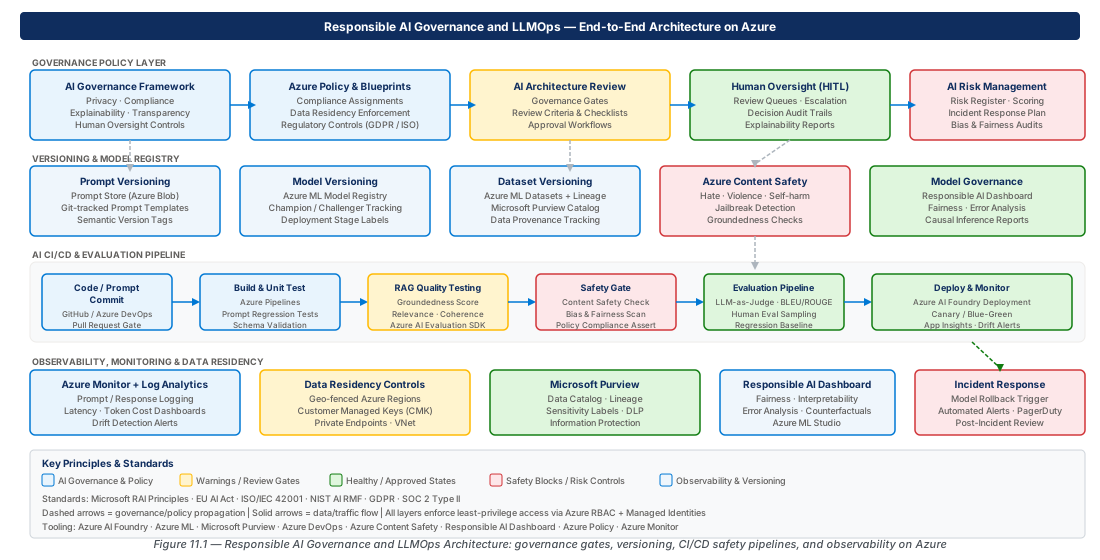
As AI systems move from isolated experiments into the operational core of enterprise platforms, responsible AI transforms from a compliance checkbox into a foundational architectural concern. This chapter establishes the governance framework that makes enterprise AI sustainable — covering privacy, compliance, explainability, and human oversight controls — and introduces the LLMOps discipline that closes the loop between model development and production reliability.
Foundations of Enterprise AI Governance
Enterprise AI governance is a multi-layer control architecture spanning data handling, model behavior, operational telemetry, and organizational accountability. It draws from established disciplines — data governance, software supply chain security, risk management — and adapts them for the unique characteristics of probabilistic AI systems: non-determinism, emergent behavior, and the difficulty of explaining individual outputs.
The Five Pillars of Responsible AI on Azure
Azure Responsible AI is organized around five interdependent pillars: Fairness, Reliability and Safety, Privacy and Security, Inclusiveness, and Transparency. Each maps to concrete Azure services that architects must wire into designs from the start. Fairness uses Azure Machine Learning (Azure ML)'s Responsible AI Dashboard with Fairlearn to quantify performance disparities across sensitive features; fairness metrics are encoded as automated gates in the model evaluation pipeline. Transparency requires Azure Model Cards and a model transparency portal aggregating evaluation reports and lineage graphs for governance stakeholders.
Privacy by Design in AI Architectures
Privacy by design for AI requires applying its seven foundational principles at every layer: data ingestion, training, evaluation, deployment, and inference. The most common failure is treating privacy as a data-at-rest concern while ignoring that trained models can memorize PII, fine-tuned models can be inverted, and RAG systems can surface confidential documents through indirect injection.
For training pipelines: data minimization, anonymization (differential privacy via SmartNoise SDK), and label-based access policies in Azure Data Lake Storage Gen2. For inference pipelines: input PII redaction, output PII filtering, and immutable audit logging of every request-response pair with caller identity.
Warning
Differential privacy guarantees are mathematical bounds on leakage — not a complete memorization defense, especially for rare training examples. Combine it with data minimization and output filtering; no single control is sufficient.
Note
Azure OpenAI PTU deployments place model weights in your tenant's compute allocation within the specified region. For strongest data residency, combine regional Azure OpenAI deployments with VNet integration and disabled public network access.
Compliance Frameworks and Regulatory Alignment
The 2026 regulatory landscape spans the EU AI Act (effective February 2025, phased obligations through August 2026), NIST AI RMF 1.0, ISO/IEC 42001, and sector-specific requirements (HIPAA, PCI DSS, FedRAMP). The EU AI Act's risk classification — Unacceptable, High Risk, Limited Risk, Minimal Risk — drives conformity assessment requirements. Most enterprise AI use cases (AI-assisted hiring, credit scoring, medical diagnosis support) fall into High Risk.
Tip
Align governance documentation with ISO/IEC 42001 from the start. Its structure maps cleanly onto Azure DevOps and Azure ML workflow stages and provides a vendor-neutral audit trail satisfying multiple regulatory frameworks simultaneously.
Content Safety, Model Governance, and AI Risk Management
Content safety in enterprise AI is a multi-layer defense architecture. Azure AI Content Safety provides the foundational moderation service, but architects must design content safety as a pipeline spanning input validation, system prompt enforcement, output classification, and human escalation — each layer catching what the previous layer misses.
Azure AI Content Safety Architecture
Azure AI Content Safety provides moderation APIs covering Hate, Sexual, Violence, and Self-Harm categories with configurable severity thresholds (0–7, typically enforced at ≥ 2 for enterprise). The pipeline pattern: user inputs pass through Content Safety before reaching the LLM; system prompts enforce role boundaries and prohibited topics; outputs pass a second Content Safety pass plus custom domain-specific classifiers. Groundedness detection addresses factual hallucinations in RAG — a low grounding score on a response signals the model is not citing retrieved documents.
Warning
Prompt injection via malicious RAG documents is a critical and frequently underestimated risk. Content Safety alone does not prevent it. Use XML delimiters for user content, apply output tracing to detect system prompt leakage, and use Azure Defender for Cloud's AI threat protection workbook for anomalous instruction alerts.
Model Governance: Lifecycle, Versioning, and Retirement
Azure ML Model Registry is the governance hub. Every registered model carries mandatory metadata: model card URI, training dataset lineage, evaluation report URI, Responsible AI Dashboard snapshot, approvals with identity and timestamp, and deployment constraints. The registry enforces a lifecycle state machine: Experimental → Staging → Production → Deprecated → Retired.
Warning
Azure OpenAI PTU deprecations are not automatic migrations. PTU capacity tied to a deprecated model version must be manually migrated to the successor model — coordinate AI platform, finance, and application teams at least 90 days before the deprecation date.
AI Risk Management and the AI Risk Register
The NIST AI RMF's four functions — Govern, Map, Measure, Manage — translate directly into architectural artifacts. The AI Risk Register catalogs identified risks with likelihood, impact, Azure mitigation, and residual risk acceptance. Each entry maps to a specific Azure service implementing the control, enabling the register to serve simultaneously as a compliance artifact and operational runbook.
| Risk Category | Example Risk | Likelihood | Impact | Azure Mitigation | Residual |
|---|---|---|---|---|---|
| Data Quality | Training data bias against minority demographic | Medium | High | Fairlearn assessment + balanced resampling | Low |
| Model | Response hallucination in regulatory content | High | Critical | Groundedness detection + human review gate | Medium |
| Operational | PTU capacity exhaustion during peak load | Medium | High | PTU + pay-as-you-go spillover routing | Low |
| Compliance | GDPR data subject access request to AI logs | Low | High | Purview data map + automated SAR workflow | Low |
| Security | Prompt injection via malicious RAG document | High | Critical | Input sanitization + structural prompt defense | Medium |
| Reputational | Harmful output to vulnerable user | Medium | Critical | Content Safety + human escalation workflow | Low |
AI Architecture Review Framework
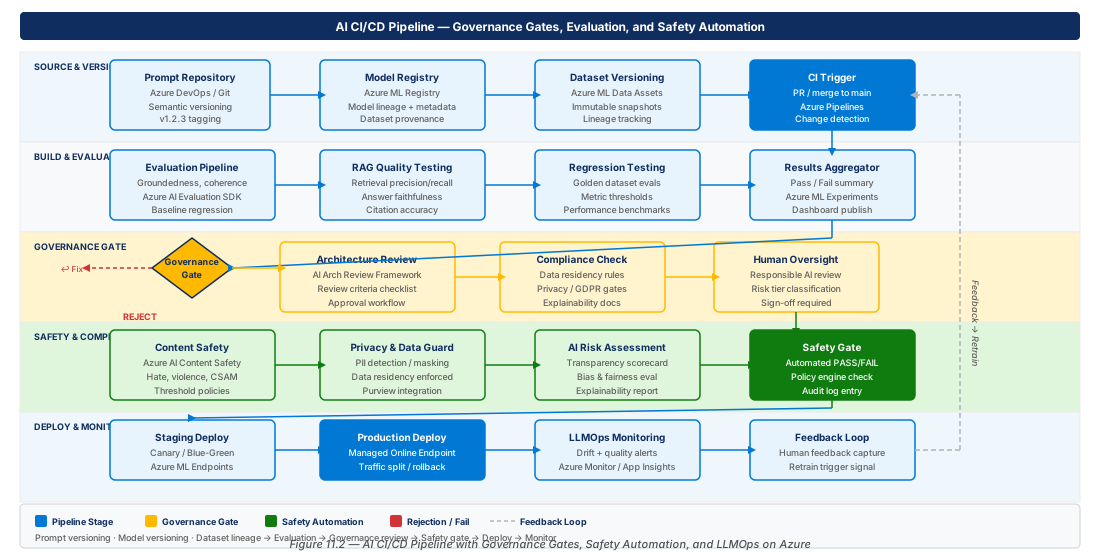
The AI Architecture Review Framework (AI ARF) extends the Azure Well-Architected Framework with AI-specific pillars and gates calibrated to system risk tier. It defines four lifecycle gates: Design Review, Pre-Deployment Review, Production Readiness Review, and Quarterly Operational Review.
Governance Gates and Review Criteria
The Design Review gate requires: EU AI Act risk tier classification, data flow diagram with sensitivity labels, privacy impact assessment, model selection rationale, evaluation strategy, and human oversight design. Approval is required before provisioning production Azure ML workspaces or Azure OpenAI PTU reservations.
The Pre-Deployment Review gate requires: completed Responsible AI Dashboard, content safety configuration tested, evaluation report meeting all thresholds, security threat model reviewed, compliance attestation signed by DPO (for GDPR-scoped systems), and deployment runbook reviewed by operations. Only then may a PR be merged to the deployment branch.
Note
The AI Architecture Review Board (AARB) requires permanent members from AI Platform Engineering, Security, Legal/Compliance, and Data Privacy. The AARB chair must document dissenting opinions — this documentation is critical for regulatory audits asking who knew what, and when.
Review Workflows and Approval Automation
Manual review creates bottlenecks that drive bypass behavior. The AI ARF is implemented as an Azure DevOps pipeline where governance artifacts are submitted as pull requests, policy-as-code checks run automatically, and human approvals are recorded with identity and timestamp. Each lifecycle gate is a pipeline stage with environment approval gates: automated Azure Policy compliance scans, Responsible AI Dashboard completeness checks, and evaluation metric threshold validation all run before the human approval gate opens.
Tip
Implement governance artifacts as code from the start: model cards in JSON-LD, evaluation thresholds in YAML, approval workflows in Azure DevOps YAML — all stored in Git and enforced by CI. This transforms governance from a documentation burden into a developer workflow.
Versioning Strategy: Prompts, Models, and Datasets
Versioning in LLMOps extends software version control to three new artifact types — prompts, models, and datasets — each with distinct versioning semantics. Without a coherent versioning strategy, AI system changes are unauditable, regression testing is impossible, and rollback under incident conditions fails.
Prompt Versioning and Management
Prompts are software artifacts that directly determine model behavior, yet are typically stored as plain text strings with no versioning discipline. A Prompt Registry implemented as Azure Cosmos DB stores prompts with schema fields: prompt_id, version (semantic version), content, model_compatibility, status (Draft / Review / Approved / Deprecated), approved_by, and approval_timestamp. Applications fetch prompts by name and explicit version — never a floating latest reference in production.
Warning
System prompt drift — modifying prompts in production without version tracking — is one of the most common causes of silent AI quality regression. Implement a read-only production prompt store where only the CI/CD pipeline can write. Never allow direct console editing of production prompts.
Model Versioning and Lineage
Azure ML Model Registry provides native version tracking. The lineage discipline connects each model version to its training dataset version, training code Git commit hash, hyperparameter configuration, and evaluation results. MLflow captures this automatically: mlflow.log_param(), mlflow.log_artifact(), mlflow.log_metrics(), and dataset version tags form the evidentiary chain regulators require to reconstruct how a production model was built and validated.
Dataset Versioning and Data Lineage
Three dataset types require versioning: training datasets, evaluation datasets (golden sets, adversarial test sets, RAG benchmarks), and retrieval datasets (RAG corpora). Azure ML Data Assets provide immutable versioning for training and evaluation datasets; Microsoft Purview provides the end-to-end lineage graph from source systems through transformation pipelines to final training datasets.
Warning
Evaluation dataset contamination — training data leaking into evaluation datasets — causes optimistically biased results. Implement an automated n-gram overlap check in the evaluation pipeline; fail the pipeline if overlap exceeds 5%.
AI CI/CD: Evaluation Pipelines, Safety Gates, and LLMOps
LLMOps applies DevOps principles — continuous integration, continuous delivery, automated testing, observability, and incident response — to the lifecycle of AI systems. The AI CI/CD pipeline is the executable implementation of the AI ARF, automating every governance check that can be automated and surfacing human review at gates that cannot.
Evaluation Pipeline Architecture
The evaluation pipeline runs on every pull request modifying a prompt, model, or retrieval corpus. Five stages: Dataset Preparation (fetch pinned evaluation dataset version, run contamination check); Model Inference (batch inference via Azure ML); Metric Computation (RAG: Answer Relevance, Groundedness, Context Precision, Recall; classification: Accuracy, F1, AUC); Threshold Validation (compare metrics against governance YAML thresholds); Report Generation (HTML artifact uploaded to Azure ML, MLflow run tagged PASS/FAIL).
Tip
Use GPT-4o as an evaluation judge for generation quality. Configure it with a detailed rubric (factual accuracy, tone compliance, citation correctness) calibrated against a human-labeled set. Judge-based evaluation catches quality regressions that lexical metrics like BLEU miss entirely.
RAG Quality Testing
RAG evaluation uses question-answer-context triples and measures four metrics: Retrieval Recall@k, Retrieval Precision@k, Answer Groundedness, and Answer Correctness. The Azure AI Evaluation SDK provides RelevanceEvaluator, GroundednessEvaluator, CoherenceEvaluator, and FluencyEvaluator as base implementations. Extend these with domain-specific evaluators — ComplianceEvaluator, CitationEvaluator — as custom Python classes following the SDK evaluator interface.
Safety Gate Automation
Safety gates are binary: a pipeline producing content safety violations must not proceed to production regardless of quality score improvements. The safety evaluation dataset is a versioned adversarial test set covering jailbreak attempts, indirect injection patterns, boundary-testing queries, and domain-specific harmful queries. The gate passes only if the harmful response rate on the adversarial dataset is zero for high-risk systems.
Warning
Adversarial test sets become stale quickly. Implement a quarterly red team rotation (internal or via Microsoft's AI Red Team service) and commit new adversarial examples directly to the versioned dataset after each exercise. A safety gate never updated provides false assurance.
Lab
CE-21: Deploy AI Governance Baseline with Azure Policy and Content Safety
Create resource groups with governance tags, assign Azure Policy for data residency enforcement, deploy Azure AI Content Safety with private endpoint, and configure diagnostic logging to Log Analytics.
SUBSCRIPTION_ID="<your-subscription-id>"
LOCATION="eastus2"
RG_PROD="rg-responsible-ai-governance-llmops-prod-001"
AI_CONTENT_SAFETY_NAME="responsible-ai-prod-eastus2-001"

az account set --subscription "$SUBSCRIPTION_ID"
az group create --name "$RG_PROD" --location "$LOCATION" \
  --tags environment=prod complianceframework=eu-ai-act dataclassification=confidential

az policy assignment create --name "restrict-ai-data-residency-prod" \
  --policy "e56962a6-4747-49cd-b67b-bf8b01975c4f" \
  --resource-group "$RG_PROD" \
  --params '{"listOfAllowedLocations":{"value":["eastus2","eastus"]}}'

az cognitiveservices account create \
  --name "$AI_CONTENT_SAFETY_NAME" --resource-group "$RG_PROD" \
  --kind ContentSafety --sku S0 --location "$LOCATION" --yes

az cognitiveservices account update \
  --name "$AI_CONTENT_SAFETY_NAME" --resource-group "$RG_PROD" \
  --public-network-access Disabled
# Store key in Key Vault — retrieve with az cognitiveservices account keys listCE-22: Build and Register an LLMOps Evaluation Pipeline with Azure ML
Create an Azure ML workspace with managed VNet, register a versioned golden evaluation dataset, register the production model with governance metadata, and submit an evaluation pipeline job that gates deployment on metric thresholds.
ML_WORKSPACE="aml-responsibleai-prod-eastus2-001"
MODEL_NAME="customer-support-rag-v2"

az ml workspace create --name "$ML_WORKSPACE" --resource-group "$RG_PROD" \
  --managed-network allow_only_approved_outbound --public-network-access Disabled

az ml data create --name "rag-golden-evaluation-dataset" --version "3.1.0" \
  --workspace-name "$ML_WORKSPACE" --resource-group "$RG_PROD" \
  --type uri_file --tags contamination_check_passed=true

az ml model create --name "$MODEL_NAME" --version "2.0.0" \
  --workspace-name "$ML_WORKSPACE" --resource-group "$RG_PROD" \
  --tags base_model="gpt-4o-2024-11-20" lifecycle_stage=Production \
         aarb_approval_id="AARB-2026-0614-007"
# Submit evaluation pipeline job and gate on EVAL_STATUS == "Completed"CE-23: Configure Prompt Registry and Version-Controlled Prompt Deployment
Deploy a Cosmos DB-backed Prompt Registry with private endpoint, register a versioned system prompt with AARB approval metadata, and configure an Azure Monitor alert rule for high-severity content safety violations.
COSMOS_ACCOUNT="cosmos-promptregistry-prod-eastus2-001"

az cosmosdb create --name "$COSMOS_ACCOUNT" --resource-group "$RG_PROD" \
  --locations regionName="$LOCATION" failoverPriority=0 isZoneRedundant=true \
  --enable-public-network false --backup-policy-type Continuous

az cosmosdb sql container create --account-name "$COSMOS_ACCOUNT" \
  --resource-group "$RG_PROD" --database-name promptregistry \
  --name prompts --partition-key-path "/promptName"

az monitor scheduled-query create \
  --name "alert-content-safety-high-severity" \
  --resource-group "$RG_PROD" --scopes "$LA_WORKSPACE_ID" \
  --condition "count > 0" --severity 1 \
  --window-size 5 --evaluation-frequency 5
# Prompt v1.3.0 registered via Cosmos DB data plane REST API
Summary
| Concept | Key Point |
|---|---|
| AI Governance Pillars | Fairness, Reliability/Safety, Privacy/Security, Inclusiveness, and Transparency map to Azure services — implement all five from project start, not as retrofits. |
| Data Residency | Enforce via Azure Policy allowed-locations assignments plus Private Endpoints; regional Azure OpenAI PTU provides the strongest LLM inference residency guarantee. |
| Content Safety Architecture | Pipeline: input sanitization → LLM inference → output filtering → groundedness check. No single control is sufficient; Prompt Shield specifically defends against indirect RAG injection. |
| AI Architecture Review Framework | Four gates (Design, Pre-Deployment, Production Readiness, Quarterly) with automated policy-as-code plus human AARB approval implemented as Azure DevOps pipeline stages. |
| Versioning Strategy | Prompts, models, and datasets are first-class versioned artifacts; MAJOR changes require full gate review, PATCH changes require only automated evaluation checks. |
| Evaluation Pipeline | Five stages: Dataset Prep → Inference → Metric Computation → Threshold Validation → Report. RAG requires Recall@k, Precision@k, Groundedness, and Correctness metrics. |
| Safety Gate Automation | Adversarial test sets are binary gates — zero harmful response rate required for production promotion on high-risk systems; red team exercises refresh the dataset quarterly. |
Chapter: 11 of 12 | Chapter Status: v0.1 Draft |