Azure AI Solutions Architecture
What an AI Solutions Architect Actually Does
Every enterprise AI initiative eventually runs into the same structural problem: a team of brilliant specialists who cannot translate their work into systems that operate reliably at scale. The AI Solutions Architect bridges that gap, converting experimental models and fragmented data pipelines into production-grade enterprise systems.
The AI Roles Taxonomy: Who Does What and Why It Matters
Why Terminology Still Causes Project Failures
Enterprise AI programs fail for many reasons, but a surprisingly common root cause is misaligned role expectations. When a Solutions Architect assumes "AI Architect" and "AI Solutions Architect" are synonyms, accountability gaps open and architectural decisions get made by whoever shows up rather than whoever holds appropriate authority.
The confusion is partly structural — the AI field evolved rapidly, and job titles were coined faster than industry consensus could catch up. The AI Solutions Architect must operate above this ambiguity, recognizing patterns of responsibility across titles and aligning them to Azure service boundaries.
Data Engineer: The Foundation of Every AI System
The Data Engineer owns the movement, transformation, and availability of data: Azure Data Factory pipelines, Azure Synapse Analytics schemas, Azure Data Lake Storage Gen2 (ADLS) Lakehouse architectures, and Delta Lake. A production ML model is only as reliable as the data pipeline feeding it — feature drift, schema changes, and latency spikes are data engineering problems, not model problems.
Data Scientist: Model Development and Experimentation
The Data Scientist translates business questions into mathematical formulations, selects and validates ML approaches, and produces trained model artifacts using Azure Machine Learning Studio with MLflow tracking. The AI Solutions Architect's job includes designing handoff points — at the model registry boundary — so Data Scientists focus on model quality while ML Engineers own operationalization.
Note
Azure Machine Learning provides a managed MLflow tracking server. Encouraging Data Scientists to log all experiments through MLflow from day one eliminates a common technical debt pattern where model provenance becomes unrecoverable after team turnover.
ML Engineer: Operationalizing Models at Scale
The ML Engineer takes trained model artifacts and builds engineering systems to serve them reliably: Docker containerization, CI/CD pipelines, Azure Machine Learning (AML) Online Endpoints or Azure Kubernetes Service (AKS) inference serving, and Feature Store design. ML Engineers think in latency percentiles, blue/green deployments, canary rollouts, and rollback procedures.
The AI Solutions Architect must draw the feature engineering boundary explicitly: features computed at training time are owned by the Data Scientist with Data Engineer collaboration; features at inference time are owned by the ML Engineer. The Feature Store is the contract point between training and serving.
AI Engineer: Integrating AI Capabilities into Applications
The AI Engineer integrates pre-built AI capabilities — Azure OpenAI Service, Azure AI Vision, Language, Speech, Document Intelligence — into applications. In a RAG architecture, the AI Engineer builds the orchestration layer: chunking, embedding, indexing in Azure AI Search, prompt construction, and response post-processing using LangChain or Semantic Kernel.
Warning
AI Engineers working with Azure OpenAI Service frequently underestimate prompt injection risks. The AI Solutions Architect must ensure all Azure OpenAI deployments route through Azure API Management with policy enforcement for input validation, and that output filtering is configured at the model deployment level.
AI Architect: Technical Depth Across the Full AI Stack
The AI Architect — distinct from AI Solutions Architect — operates within a product or platform team, owning end-to-end technical design from data ingestion through monitoring. They author Architecture Decision Records, define golden paths for the team, and escalate complex cross-role technical problems.
The key differentiator: an AI Architect is optimized for technical depth within the AI domain; an AI Solutions Architect is optimized for breadth across the enterprise technology portfolio, regulatory landscape, and business strategy.
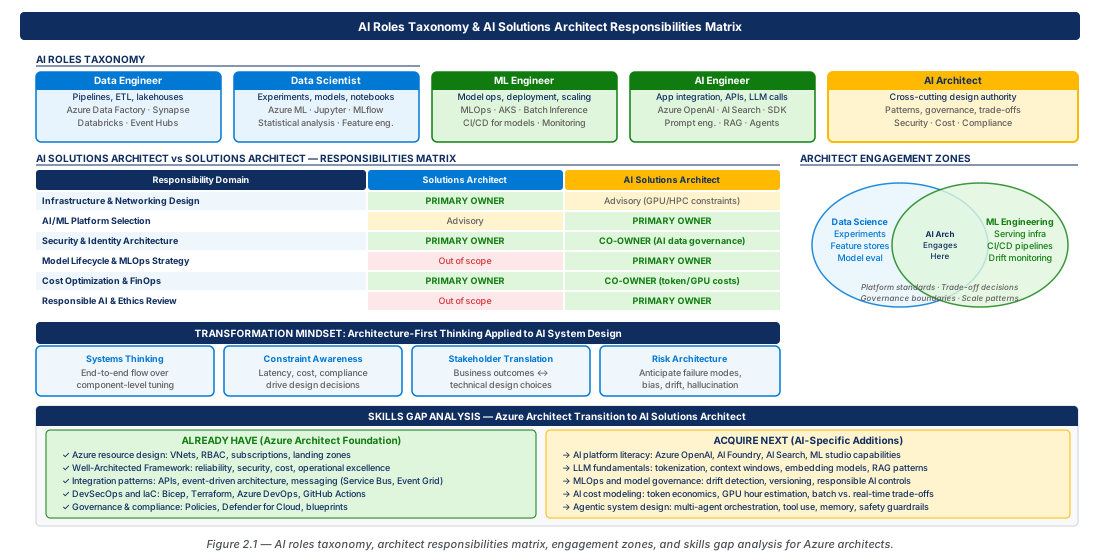
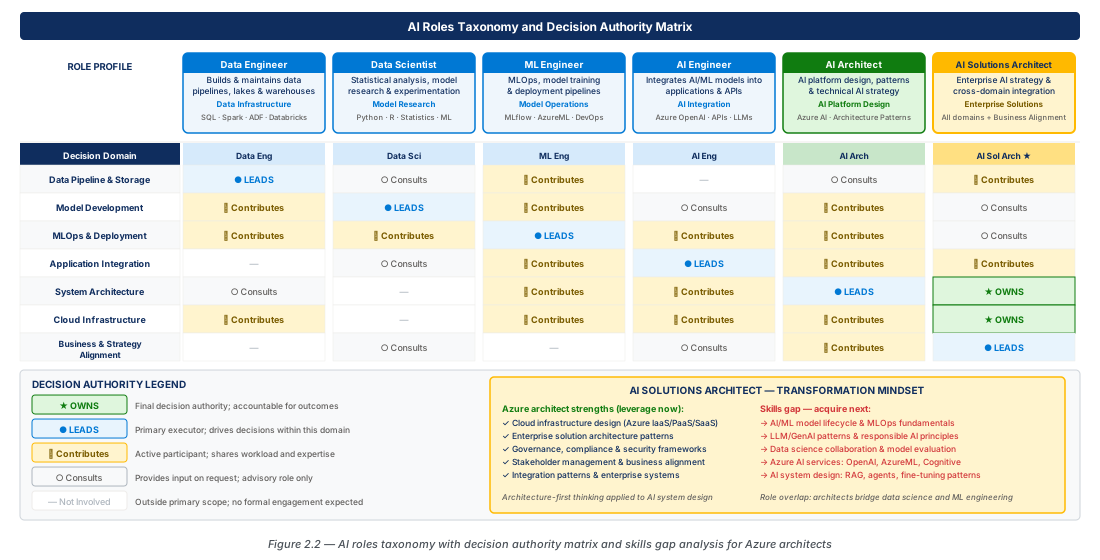
AI Solutions Architect vs. Solutions Architect: Responsibilities Matrix and Decision Authority
What the Traditional Solutions Architect Already Owns
The traditional Azure Solutions Architect (AZ-305) is accountable for reliable, secure, cost-optimized solutions across the full Azure portfolio: Entra ID, Virtual Networks, hub-and-spoke, Private Link, AKS, Container Apps, and data platform design. They hold authority to approve or reject architectural patterns at landing zone and workload levels.
This is important when scoping the AI Solutions Architect role: the organization is not hiring a replacement for its Solutions Architect — it is extending that capability into the AI domain. Identity, network, compliance, and enterprise integration skills are the foundation, not a gap.
The Additive Responsibilities of the AI Solutions Architect
The AI Solutions Architect inherits all traditional Solutions Architect domain authority and adds five categories: AI platform governance (Azure AI service catalog, model version management), data strategy for AI (data domains, residency requirements, tiering in ADLS), responsible AI governance (Microsoft Responsible AI (RAI) principles as engineering constraints, Content Safety, human-in-the-loop workflows), AI system economics (GPU-hour costs, token consumption, build-versus-buy), and cross-role orchestration (ensuring all four specialist roles work from a coherent architectural vision).
Decision Authority Matrix
Tip
Organizations should publish this decision authority matrix as a living document in their internal wiki. Ambiguity about decision authority is the single most common cause of delayed AI deployments — not technical complexity.
| Decision Category | Primary Authority | Advisory Roles | Azure Enforcement |
|---|---|---|---|
| Azure subscription and management group topology | AI Solutions Architect | Cloud Platform Team | Azure Policy, Management Group hierarchy |
| Azure OpenAI model version approval for production | AI Solutions Architect | AI Architect, CISO | Azure AI Foundry deployment approval workflow |
| ML training compute SKU selection | AI Architect | ML Engineer, FinOps | Azure Policy allowed VM SKU list |
| Feature store schema changes | ML Engineer | Data Engineer, Data Scientist | AML Feature Store version control |
| Model promotion from staging to production | ML Engineer | Data Scientist, AI Solutions Architect | AML Model Registry approval gate |
| Responsible AI risk assessment | AI Solutions Architect | Compliance Officer, AI Architect | Azure AI Content Safety, RAI dashboard |
| Data retention policy for training datasets | AI Solutions Architect | Data Engineer, Legal/Compliance | Azure Storage lifecycle policies, Purview |
| Azure OpenAI prompt template versioning | AI Engineer | AI Architect | Azure API Management policy versioning |
| AI system incident response playbook | AI Solutions Architect | ML Engineer, SRE | Azure Monitor alert rules, AML monitoring |
| Training/inference cost budget allocation | AI Solutions Architect | FinOps, AI Architect | Azure Cost Management budgets and alerts |
Role Overlap Map: Where Architects Engage With Data Science and ML Engineering
The Architect's Engagement Surface with Data Science
The AI Solutions Architect engages with the data science function at four specific points: problem framing (validating that the AI approach is architecturally sound before EDA begins), training infrastructure design (AML compute cluster configuration, ADLS access patterns, network security controls), model evaluation governance (defining minimum acceptance criteria: performance thresholds, fairness metrics, data drift sensitivity), and retraining strategy design (how often, what triggers, how orchestrated, how validated without service interruption).
Warning
A common production failure occurs when organizations treat the initial model training pipeline as the production retraining pipeline. The initial pipeline uses static dataset snapshots and manual execution; the production pipeline requires dynamically windowed data, automated validation gates, and zero-downtime deployment.
The Architect's Engagement Surface with ML Engineering
The AI Solutions Architect's engagement with ML Engineering is more continuous because ML Engineering owns production systems. The three engagement surfaces are: inference serving design (AML Managed Online Endpoints vs. AKS, traffic split for A/B testing, auto-scaling policy), feature serving architecture (real-time features in Azure Cache for Redis or Cosmos DB, synchronization with offline Delta Lake feature store), and MLOps pipeline design (logical design of the end-to-end pipeline from code commit through monitoring — the architect owns design, the ML Engineer owns implementation).
The Transformation Mindset: Architecture-First Thinking Applied to AI System Design
What "Architecture-First" Means in Practice
Architecture-first thinking evaluates every technical decision against system-level constraints before local optimization. A Data Scientist asks which algorithm maximizes validation accuracy; an AI Solutions Architect asks whether that algorithm meets inference latency SLA, fits serving infrastructure memory, and satisfies data governance policy — and approves only when all three constraints are met.
The practical expression of architecture-first thinking is the Architecture Decision Record (ADR). Every non-trivial design decision — serving infrastructure, vector database selection, Azure OpenAI versus fine-tuned open-source — should be documented with context, options considered, decision made, and consequences. ADRs create an audit trail and serve as the reference when a security review or compliance audit challenges a deployment decision.
Translating Across Abstraction Levels
An effective AI Solutions Architect operates comfortably across multiple abstraction levels — executive AI strategy conversations, Azure landing zone technical design, inference API contract code review — without losing credibility at any level. This requires genuine technical depth at each level, not communication skill alone.
Note
The Azure AI Fundamentals (AI-900) and Azure Data Scientist Associate (DP-100) certification paths are valuable because exam preparation systematically exposes the architect to vocabulary, concepts, and decision frameworks of each domain — precisely the fluency the transformation mindset requires.
Building the Architecture-First Culture in an AI Team
The most effective practices are structural: automated quality gates in the MLOps pipeline, mandatory architecture review for new AI use cases, production readiness checklists (SLA, monitoring strategy, runbook, rollback procedure), and cost attribution (every AML workspace and Azure OpenAI deployment tagged with cost center, team, and workload identifiers).
Skills Gap Analysis: What Azure Architects Already Have and What to Acquire Next
The Strong Foundation Azure Architects Bring
Azure identity and access management maps to AI system security: Managed Identities for AML compute, role-based access control (RBAC) roles for AML workspace, Private Link for AML and Azure OpenAI. Network architecture maps to AI system isolation: compute clusters in dedicated subnets with Network Security Group (NSG) restrictions. Landing zone design maps to AI platform governance: management group hierarchy, Azure Policy for AI service configuration, subscription vending for new AI project teams.
The Skills Azure Architects Need to Acquire
The gaps fall into three categories. AI domain vocabulary (supervised vs. unsupervised learning, classification vs. regression, foundation vs. fine-tuned model, vector embedding) can be acquired in 60–90 days through structured self-study. Azure AI service specifics (AML workspace governance, Azure OpenAI PTU vs. token-based, AI Foundry, AI Search, Content Safety) require hands-on labs. AI governance frameworks (Microsoft Responsible AI Standard, EU AI Act, NIST AI RMF, sector-specific guidelines) represent the deepest gap.
Tip
Architects should not attempt to close all gaps simultaneously. Prioritize Azure Machine Learning platform and Azure OpenAI skills first — highest immediate utility — then layer in governance and economics depth over the following six months.
| Skill Domain | Current (AZ-305) | Target (AI SA) | Acquisition Path | Timeline |
|---|---|---|---|---|
| Azure IAM, Networking, Landing Zone, Cost Mgmt | Expert/Proficient | No gap | — | — |
| ML lifecycle vocabulary | Beginner | Proficient | AI Fundamentals path, Chip Huyen's book | 60–90 days |
| Azure Machine Learning platform | Beginner–Intermediate | Advanced | DP-100 prep, hands-on labs | 90–120 days |
| Azure OpenAI and AI Services | Beginner–Intermediate | Advanced | AI-102 prep, hands-on labs | 60–90 days |
| MLOps pipeline design | None | Intermediate | Azure MLOps docs, CE labs in this book | 90–120 days |
| RAG architecture design | None | Advanced | Azure AI Search docs, AI Foundry labs | 60–90 days |
| Responsible AI governance | Beginner | Proficient | Microsoft RAI Standard, EU AI Act, NIST AI RMF | 90–120 days |
| AI system economics | Intermediate | Advanced | FinOps Foundation AI Cost Management module | 30–60 days |
Lab: Provision a Governed AI Solutions Architect Reference Environment
CE-03: Provision AML Workspace with Managed VNet Isolation
Create resource groups with Cloud Adoption Framework (CAF)-compliant naming and tags, provision the supporting infrastructure (storage, Key Vault, Azure Container Registry (ACR), App Insights), and create an AML workspace with public network access disabled and managed VNet isolation enabled.
LOCATION="eastus2"
RG_PROD="rg-ai-solutions-architect-role-prod-001"
az group create --name "${RG_PROD}" --location "${LOCATION}" \
  --tags "environment=prod" "costCenter=AI-Platform"
az ml workspace create --name "ai-solutions-prod-eastus2-001" \
  --resource-group "${RG_PROD}" --location "${LOCATION}" \
  --public-network-access "Disabled" \
  --managed-network "allow_internet_outbound"
# ... assign RBAC roles per decision authority matrix ...CE-04: Configure Azure Policy Governance for the AI Platform Landing Zone
Apply Azure Policy assignments that enforce the AI Solutions Architect's governance decisions: diagnostic settings on AML workspaces, mandatory tagging for cost attribution, and a Cost Management budget with 80%/100% forecast alerts.
SUBSCRIPTION_ID=$(az account show --query id -o tsv)
# Assign built-in policy: Require diagnostic settings on AML workspaces
az policy assignment create --name "pa-aml-diagnostic-settings-prod" \
  --policy "/providers/Microsoft.Authorization/policyDefinitions/1fa8b959-243b-4d3e-8e42-6b3b9ac41ee8" \
  --scope "/subscriptions/${SUBSCRIPTION_ID}/resourceGroups/${RG_PROD}"
az consumption budget create --budget-name "budget-ai-arch-prod" \
  --amount 5000 --time-grain "Monthly" \
  --resource-group "${RG_PROD}"
# ... add notification thresholds at 80% and 100% forecast ...
Chapter 2 Key Takeaways
The following table consolidates the core concepts covered in this chapter: the five AI specialist roles, the additive responsibilities of the AI Solutions Architect, and the recommended skills acquisition timeline.
| Topic | Key Concept | Azure Service / Mechanism | Architect Action |
|---|---|---|---|
| Role: Data Engineer | Owns data movement, transformation, and availability; data pipeline reliability is the AI system foundation | Azure Data Factory, Azure Synapse Analytics, ADLS Gen2, Delta Lake | Define handoff contracts at storage layer; enforce schema governance |
| Role: Data Scientist | Translates business questions into ML formulations; produces trained model artifacts | Azure Machine Learning Studio, MLflow tracking, AML Model Registry | Design model registry boundary; define minimum acceptance criteria |
| Role: ML Engineer | Operationalizes models into reliable serving systems; owns production inference infrastructure | AML Managed Online Endpoints, AKS, Feature Store, CI/CD pipelines | Draw feature engineering boundary; approve serving architecture design |
| Role: AI Engineer | Integrates pre-built AI capabilities into applications; builds RAG orchestration layers | Azure OpenAI Service, Azure AI Search, LangChain, Semantic Kernel, API Management | Enforce prompt injection controls; mandate API Management routing |
| Role: AI Architect | Owns end-to-end technical design within a product team; depth-focused across the AI stack | Architecture Decision Records, golden paths, AI platform team scope | Differentiate from AI Solutions Architect; avoid authority overlap |
| Additive Responsibility: AI Platform Governance | Owns Azure AI service catalog approval and model version management | Azure AI Foundry deployment approval workflow, Azure Policy | Publish decision authority matrix; chair model promotion gate |
| Additive Responsibility: Data Strategy for AI | Defines data domains, residency requirements, and tiering for AI workloads | ADLS Gen2, Azure Purview, Storage lifecycle policies | Approve data retention policies; enforce data residency by region |
| Additive Responsibility: Responsible AI Governance | Applies Microsoft Responsible AI (RAI) principles as engineering constraints | Azure AI Content Safety, RAI dashboard, human-in-the-loop workflows | Own risk assessment; integrate Content Safety into all OpenAI deployments |
| Additive Responsibility: AI System Economics | Manages GPU-hour costs, token consumption, and build-versus-buy decisions | Azure Cost Management, FinOps Foundation AI Cost Management module | Tag all AML/OpenAI resources; set budget alerts at 80%/100% forecast |
| Additive Responsibility: Cross-Role Orchestration | Ensures all four specialist roles work from a coherent architectural vision | Azure DevOps, MLOps pipelines, Architecture Review Board | Run architecture reviews; maintain the living decision authority matrix |
| Skills Gap: AI Domain Vocabulary | Supervised/unsupervised, classification/regression, foundation vs. fine-tuned model, vector embedding | AI-900 certification, Chip Huyen's Designing Machine Learning Systems | 60–90 days structured self-study |
| Skills Gap: Azure AI Services | AML workspace governance, Azure OpenAI PTU vs. token-based pricing, AI Foundry, AI Search, Content Safety | DP-100, AI-102 certification paths, Azure hands-on labs | 60–120 days hands-on practice |
| Skills Gap: AI Governance Frameworks | Microsoft Responsible AI Standard, EU AI Act, NIST AI Risk Management Framework (RMF), sector-specific guidelines | Microsoft RAI Standard documentation, NIST AI RMF, EU AI Act compliance guides | 90–120 days; deepest gap, highest long-term leverage |
Chapter: 2 of 12 | Status: v0.1 Draft |