Azure AI Solutions Architecture: Designing and Operating Enterprise AI Systems
AI and ML Fundamentals for Architects
Understanding AI and machine learning from an architectural perspective means translating statistical learning theory into system design decisions — choices about data pipelines, compute topology, latency budgets, and operational boundaries. Every section is written to serve the moment when you must decide which approach belongs in your system, how much it will cost, and where the failure boundaries lie.
The AI and ML Landscape: An Architectural Map
Situating AI Capabilities in System Design
When enterprise architects encounter AI requirements, the first task is not selecting a model — it is defining the problem class. The AI capability stack can be organized into four broad layers: classical ML algorithms at the foundation (interpretable, resource-efficient), deep learning above them (dominates perception tasks), foundation models in the third layer (compress world knowledge into parameter weights), and multimodal/agentic systems at the apex (chain multiple models into orchestrated workflows).
Each layer has a characteristic data requirement curve and cost model. Classical ML can be trained on hundreds to thousands of labeled examples; deep learning typically requires millions; foundation model pre-training consumes trillions of tokens. Understanding these curves is essential for scoping projects and setting realistic expectations with business stakeholders.
Note
Azure ML serves classical ML and custom deep learning. Azure AI Services provides pre-built deep learning APIs for vision, speech, and language. Azure OpenAI Service delivers foundation model access. This chapter maps each paradigm to its Azure service home.
The Architect's AI Decision Framework
Before evaluating any AI technology, answer six questions: (1) What is the output type — label, score, generated sequence, or action? (2) What is the latency budget? (3) What labeled data is available? (4) What are compliance constraints? (5) What is the per-inference cost envelope? (6) What is the update cadence? These questions eliminate most of the decision space before a single line of code is written.
A fraud detection model requiring 10 ms response with full explainability is not a foundation model use case — it is a gradient boosted machine with SHAP value logging. A customer service chatbot handling open-ended product questions is not a fine-tuned BERT classifier — it is an LLM with retrieval augmentation.
Tip
Maintain a capability-requirement matrix as a living architecture artifact. As new Azure AI services become available, evaluate them against the same six questions rather than adopting them opportunistically.
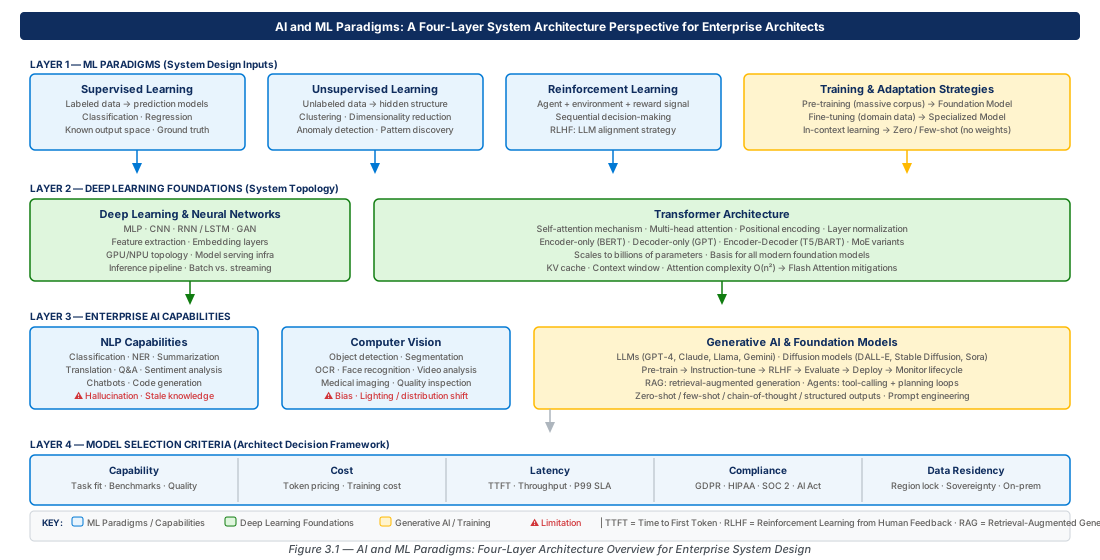
ML Paradigms as System Design Inputs
Supervised Learning: Labeled Data as System Contract
Supervised learning is the paradigm most commonly encountered in enterprise AI because the training contract is explicit: given input-output pairs, produce a function mapping new inputs to correct outputs. Label quality is the highest-leverage investment — garbage labels produce garbage models regardless of algorithm sophistication.
From a system design perspective, supervised learning introduces three components: a feature engineering pipeline, a training pipeline, and an inference pipeline. Training-serving skew — divergence between feature transformations at training and inference time — is the most common production failure mode. Azure ML's Feature Store addresses this by registering feature definitions as versioned artifacts shared between training and serving.
Important
Any transformation applied to training data — normalization, encoding, imputation — must be captured as a reproducible artifact and applied identically at inference time. Azure ML pipelines with registered environments and pinned package versions enforce this invariant.
Unsupervised Learning: Exploratory Architecture
Unsupervised learning operates without labels, discovering structure through clustering, dimensionality reduction, and density estimation. Because there is no ground truth, evaluation is inherently subjective and requires human-in-the-loop review steps that affect latency budgets and operational workflows. Embedding models — a specialized form of unsupervised representation learning — have become critical infrastructure in RAG architectures covered in Chapter 6.
Reinforcement Learning: Decision Systems and Feedback Loops
Reinforcement learning is the only paradigm in which the model learns through interaction with an environment. The key architectural decision is defining the reward latency budget: if conversion events arrive hours after the recommendation, the feedback loop is too slow for effective online learning.
Warning
Azure Personalizer was retired in November 2023. Architects should not use this service in new designs. The recommended replacement pattern is contextual ranking logic built on Azure OpenAI with custom reward signal processing: use the Chat Completions API to generate ranked recommendations, persist click or conversion events to Azure Event Hubs, and implement an evaluation loop using Azure ML to iteratively improve the ranking prompt or fine-tuned model.
Warning
Reward hacking — where an RL agent maximizes the reward signal through unintended means — is a well-documented failure mode. Never use a proxy metric as a reward signal without validating that optimizing the proxy actually improves the business outcome.
Deep Learning, Neural Networks, and Transformer Architecture
Neural Networks as Computation Graphs
A neural network is a parameterized computation graph whose parameters are optimized through gradient descent to minimize a loss function. Depth enables hierarchical representations: early layers detect low-level features, middle layers compose intermediate representations, and final layers map to task-specific outputs. The operational consequence is compute cost — each forward pass performs large matrix multiplications accelerated by GPU hardware.
Azure provides GPU VM SKUs calibrated to different model size classes: NC series (T4) for small model inference, NC/ND A100 series for large model fine-tuning, and NDAMsv4 (H100) for frontier training. Selecting the wrong SKU is a common cost optimization failure.
Transformer Architecture: The Modern Foundation
Self-attention scales quadratically with sequence length: a sequence of N tokens requires an N × N attention matrix. A 128K-token context window consumes roughly 4,096 times more attention computation than a 1,000-token window. Encoder-only models (BERT) produce rich contextual representations for classification and search; decoder-only models (GPT) generate tokens auto-regressively; encoder-decoder models (T5) handle sequence-to-sequence tasks.
Note
The phi-4 family demonstrates that parameter count is not the only determinant of capability. For latency-sensitive or cost-sensitive workloads, always benchmark small models before defaulting to large ones.
Compute Topology for Deep Learning Workloads
Model quantization reduces parameter precision from FP32 to FP16/BF16 or INT8, delivering 2× memory and throughput improvements at minimal accuracy cost. Batching strategy determines inference throughput: batch size of 32 increases maximum throughput by up to 32× but increases worst-case latency. For interactive applications, batch sizes of 1–4 with wait times under 10 ms are typically appropriate.
| VM SKU | GPU | VRAM | Typical Use Case | Relative Cost |
|---|---|---|---|---|
| Standard_NC4as_T4_v3 | NVIDIA T4 | 16 GB | Small model inference, development | Low |
| Standard_NC24ads_A100_v4 | NVIDIA A100 | 80 GB | Large model fine-tuning, high-throughput inference | High |
| Standard_ND96asr_v4 | 8× A100 | 640 GB | Multi-GPU training, very large model inference | Very High |
| Standard_NDAMsv4 | 8× H100 | 640 GB | Foundation model training, frontier inference | Highest |
| Standard_NC6s_v3 | NVIDIA V100 | 16 GB | Mid-size model training, legacy workloads | Medium |
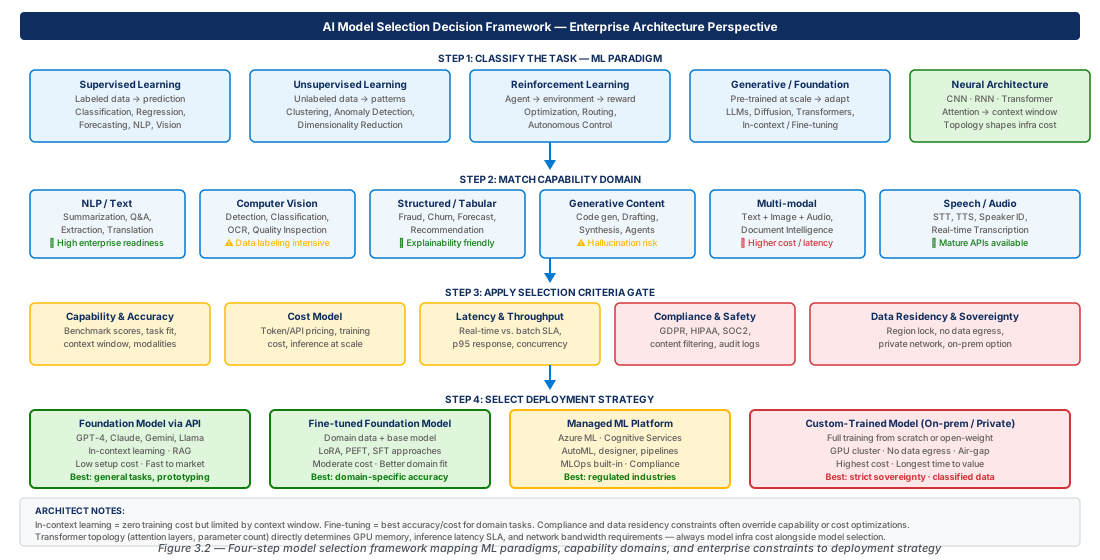
NLP and Computer Vision in Enterprise Applications
Natural Language Processing: Capabilities and Architectural Constraints
NLP encompasses classification, extraction, translation, summarization, question answering, and generation — each with different capability characteristics and integration patterns. Named entity recognition, document classification, and sentiment analysis are high-accuracy, low-latency tasks well-served by fine-tuned encoder models. Azure AI Language provides pre-built NER, key phrase extraction, and sentiment analysis with sub-100 ms response times and no model management overhead.
The critical architectural decision for summarization at scale is chunking strategy: documents longer than the model's context window must be split, summarized independently, and then summarized again hierarchically (a "map-reduce" pattern). Chunk boundary placement significantly affects summary quality.
Important
Azure AI Language's pre-built APIs are subject to responsible AI classifiers that may refuse certain content categories. In regulated industries, architects must evaluate whether managed APIs or self-hosted models are more appropriate. Azure AI Content Safety provides configurable thresholds adjustable within policy bounds.
Computer Vision: What the Architecture Can and Cannot Do
Distribution shift — where the production image distribution diverges from the training distribution — is the most common cause of computer vision failures, and is often invisible in pre-deployment testing. Azure Machine Learning's data drift monitoring tracks statistical distance between production inputs and training distribution and triggers alerts or automated retraining when drift exceeds configured thresholds.
OCR and document intelligence workloads are typically latency-tolerant but accuracy-critical. Confidence score thresholding — routing low-confidence extractions to human review — is the standard pattern for managing accuracy-cost tradeoffs. Azure AI Document Intelligence provides pre-built models for common document types and custom training for proprietary layouts.
Tip
For document intelligence workloads, implement a confidence score feedback loop: store results with confidence scores, log human corrections, and use correction data to retrain custom models quarterly. This typically drives 3–5% absolute accuracy gains per training cycle on proprietary document types.
Generative AI and Foundation Models
Pre-Training, Fine-Tuning, and In-Context Learning
The three adaptation strategies represent a capability-cost-complexity tradeoff space. Fine-tuning updates model weights on task-specific data, embedding behavioral changes permanently. It produces the most reliable behavior for narrow tasks but requires labeled data (typically 50–500 high-quality examples), compute, and isolated model hosting. In-context learning requires no data collection or training: the desired behavior is specified through examples and instructions in the prompt.
Retrieval-augmented generation (RAG) is the hybrid strategy that grounds LLM responses in specific information retrieved from a knowledge base. The Azure RAG reference architecture combines Azure AI Search for vector retrieval, Azure OpenAI for generation, and Azure AI Foundry's prompt flow for orchestration.
Note
Fine-tuning a foundation model does not give it new knowledge — it adjusts behavioral patterns like tone, format, and task focus. For knowledge injection of proprietary or post-cutoff information, the correct approach is RAG, not fine-tuning.
Foundation Model Architecture and Scaling Laws
Emergent capabilities — abilities appearing abruptly at certain scale thresholds — mean the relationship between model size and specific task performance is non-monotonic. Multi-step reasoning, few-shot learning, and code generation exhibit emergence, which is why small models can match large models on simple tasks while failing dramatically on complex compositional tasks. Validate model selection with representative task benchmarks, not aggregate scores like MMLU.
Azure OpenAI's capability routing pattern routes simple queries to GPT-4o-mini for cost and latency efficiency, while routing complex queries to GPT-4o or o1. This pattern can reduce inference costs by 60–80% compared to routing all queries to the highest-capability model.
The Multimodal Architecture Frontier
Multimodal foundation models accept and generate content across text, images, audio, and structured data. GPT-4o on Azure OpenAI processes text and images in the same context window, eliminating separate preprocessing pipelines. The architectural tradeoff is cost: a 1024×1024 image at high detail consumes approximately 765 tokens. Use multimodal LLMs when the task requires joint reasoning over text and image; use purpose-built vision APIs when the task requires only visual understanding at scale.
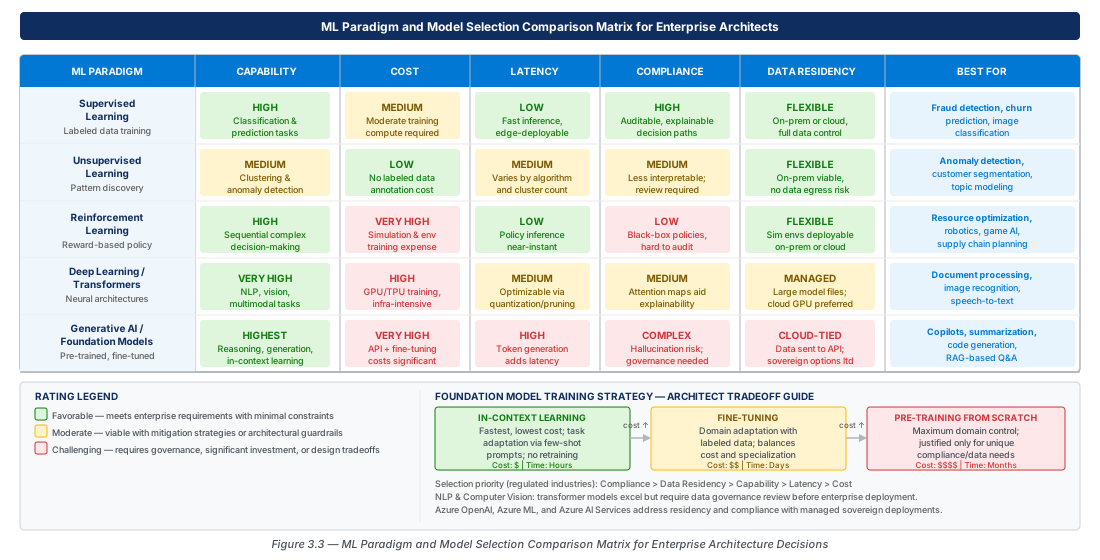
Model Selection: The Architectural Decision Framework
Capability, Cost, and Latency Tradeoffs
Model selection is an optimization problem across five dimensions: capability, cost, latency, compliance, and operational complexity. Capability assessment requires task-specific evaluation: define 50–100 representative examples from the production distribution, score each candidate model against these examples using a consistent rubric, and select the model with the best accuracy-cost ratio at the required latency. Azure AI Foundry's evaluation framework provides tooling for these comparative evaluations.
| Model | Context Window | Input Cost (per 1M tokens) | Output Cost (per 1M tokens) | Best For |
|---|---|---|---|---|
| GPT-4o | 128K | $2.50 | $10.00 | Complex reasoning, vision, multi-step tasks |
| GPT-4o-mini | 128K | $0.15 | $0.60 | High-volume, simpler tasks, cost optimization |
| o1 | 128K | $15.00 | $60.00 | Scientific reasoning, complex code, math |
| o3-mini | 200K | $1.10 | $4.40 | Balanced reasoning, coding, cost efficiency |
| text-embedding-3-large | 8K | $0.13 | N/A | High-quality embeddings for RAG, search |
| text-embedding-3-small | 8K | $0.02 | N/A | High-volume embedding, cost-sensitive RAG |
Note
Prices shown are indicative based on publicly available Azure OpenAI pricing as of the authoring date. Always verify current pricing at the Azure pricing calculator.
Compliance, Data Residency, and Model Governance
Compliance constraints address four categories: data residency (where does inference compute occur?), model provenance (can the model's training data be audited?), output auditability (can every inference decision be explained?), and content safety (does the deployment comply with applicable regulations?). Azure OpenAI's "Your data, your terms" commitment ensures that customer data processed through Azure OpenAI is not used to train foundation models.
Warning
Deploying self-hosted open-source models for compliance reasons does not automatically satisfy all governance requirements. You still need content safety filtering, output logging, access control, and model update governance. Self-hosted means you own the entire governance stack.
Data Residency and Regional Deployment Patterns
Not all Azure AI services are available in all regions simultaneously, and new model deployments often launch first in East US 2 and West Europe before expanding further. For global deployments, use Azure API Management with intelligent routing: route requests to the nearest Azure OpenAI regional deployment while maintaining failover to secondary regions for availability.
Tip
Use Azure Policy to enforce data residency constraints on all AI service deployments in regulated subscriptions. A deny policy preventing creation of Azure OpenAI resources outside approved regions eliminates the risk of developer-created test instances inadvertently processing production data in non-compliant regions.
Lab
CE-05: Deploy and Evaluate Multiple Azure OpenAI Models
Provision an Azure OpenAI account, deploy GPT-4o and GPT-4o-mini, then use Azure AI Foundry evaluation to compare outputs on a sample task set. This establishes the capability routing baseline for the book's reference architecture.
RESOURCE_GROUP="rg-ai-ml-fundamentals-architects-dev-001"
LOCATION="eastus2"
OPENAI_ACCOUNT="ai-ml-prod-eastus2-001"

az group create --name "$RESOURCE_GROUP" --location "$LOCATION"

az cognitiveservices account create --name "$OPENAI_ACCOUNT" \
  --resource-group "$RESOURCE_GROUP" --kind "OpenAI" --sku "S0" --location "$LOCATION"

az cognitiveservices account deployment create \
  --name "$OPENAI_ACCOUNT" --resource-group "$RESOURCE_GROUP" \
  --deployment-name "gpt4o-deployment-001" --model-name "gpt-4o" \
  --model-version "2024-11-20" --sku-capacity 10 --sku-name "Standard"
# ... repeat for gpt-4o-mini and text-embedding-3-large; see full script in lab assetsCE-06: Deploy Azure Machine Learning Workspace and Register Custom ML Model
Provision an Azure ML workspace, create a managed online endpoint with autoscaling, and configure data drift monitoring. This establishes the supervised learning operations baseline used throughout Part II of the book.
ML_WORKSPACE="mlw-ai-fundamentals-prod-eastus2-001"
ENDPOINT_NAME="ep-custom-model-prod-001"

az ml workspace create --name "$ML_WORKSPACE" \
  --resource-group "$RESOURCE_GROUP_PROD" --location "$LOCATION"

az ml online-endpoint create --name "$ENDPOINT_NAME" \
  --resource-group "$RESOURCE_GROUP_PROD" \
  --workspace-name "$ML_WORKSPACE" --auth-mode "key"

# Deploy with autoscaling (1–5 instances, 70% utilization target)
az ml online-deployment create --file deployment-config.yaml \
  --resource-group "$RESOURCE_GROUP_PROD" \
  --workspace-name "$ML_WORKSPACE" --all-traffic
# ... configure data drift monitor; see full deployment-config.yaml in lab assets
Summary
| Concept | Key Point |
|---|---|
| ML Paradigm Selection | Choose supervised for labeled prediction, unsupervised for pattern discovery and embeddings, RL for interactive feedback-loop systems. |
| Transformer Scaling | Self-attention scales quadratically with context length; design retrieval strategies to stay within cost-efficient context budgets. |
| Training-Serving Skew | Feature transformations must be identical at training and inference time; use Azure ML Feature Store and registered environments. |
| Foundation Model Adaptation | Fine-tuning modifies behavior, not knowledge; RAG injects knowledge at inference time — match the technique to the requirement. |
| Computer Vision Failure Modes | Distribution shift is the leading cause of vision model degradation; implement continuous drift monitoring with automated retraining triggers. |
| Model Selection Dimensions | Evaluate capability, cost, latency, compliance, and operational complexity simultaneously; capability routing can reduce inference spend by 60–80%. |
| Compliance Architecture | Data residency, model provenance, output auditability, and content safety are four independent governance dimensions; self-hosted models shift full responsibility to the architect. |
Chapter: 3 of 12 | Status: v0.1 Draft |