Azure AI Solutions Architecture: Designing and Operating Enterprise AI Systems
AI Observability, FinOps, and Enterprise AI Platform
Enterprise AI systems deployed at scale require the same operational rigor applied to mission-critical infrastructure: deep observability into system behavior, rigorous financial governance over consumption, and a reference architecture that unifies every design principle covered in this book. This final chapter equips architects with the observability frameworks, FinOps models, and career pathways needed to sustain and advance enterprise AI platforms over time.
1. Foundations of AI Observability
Why Traditional Monitoring Falls Short for AI Systems
Traditional APM was designed for deterministic systems where a request arrives, code executes, and a response returns. Enterprise AI systems break this contract at every layer—a single query may invoke a retrieval pipeline, route through multiple agents, call external tools, and consume thousands of tokens before returning a probabilistically correct response. Legacy stacks instrument CPU, memory, throughput, and error rates, which remain necessary but are insufficient for AI workloads that can hallucinate, retrieve irrelevant documents, or burn through token budgets silently.
Azure Monitor and Application Insights form the telemetry backbone, but they require deliberate instrumentation to capture AI-specific signals. Azure AI Foundry emits built-in metrics for token usage and latency; Azure AI Evaluation provides batch-based quality scoring. Combining real-time operational telemetry with periodic quality evaluation creates the dual-layer observability model that enterprise AI demands.
The AI Observability Stack
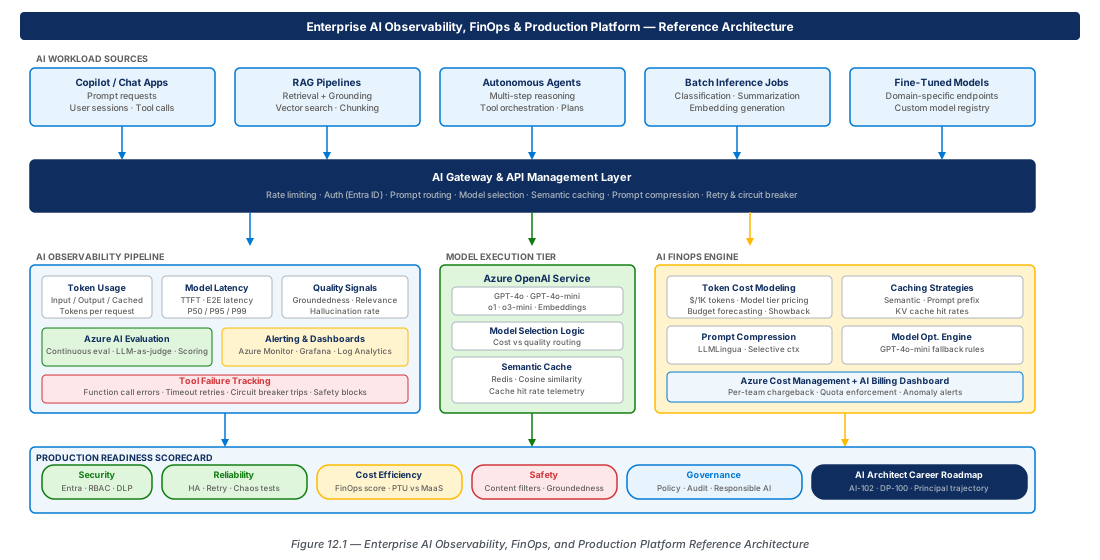
The AI observability stack organizes signals into four tiers: infrastructure (compute, network, storage), model (token consumption, latency, throttling, API errors), quality (groundedness, relevance, hallucination rate, safety violations, agent task completion), and business (task deflection rates, CSAT, revenue attribution). Each tier has different instrumentation requirements, data retention needs, and alerting thresholds.
Azure Log Analytics serves as the unified sink for all four tiers. Custom tables capture structured AI telemetry that standard Azure Monitor schemas do not natively support. Azure Monitor Alerts fire on threshold violations across all tiers, enabling both reactive incident response and proactive capacity management.
2. Implementing AI Observability: Metrics, Traces, and Evaluation
Token Usage and Model Latency Instrumentation
Token usage is the primary cost and capacity driver in AI systems. Architects must instrument token telemetry at the SDK layer using OpenTelemetry semantic conventions for generative AI—each LLM invocation emits a span with gen_ai.usage.input_tokens, gen_ai.usage.output_tokens, gen_ai.request.model, and gen_ai.response.finish_reason. Azure API Management's AI Gateway adds a policy-level token metering layer that enforces per-subscription limits before requests reach the model.
Model latency has multiple components: time-to-first-token (TTFT) drives perceived responsiveness and improves with PTUs and regional proximity; total generation time scales with output token count and improves with output limits and streaming; infrastructure latency improves with Private Endpoints and co-location.
# Create resource group and Log Analytics workspace
az group create \
  --name rg-ai-observability-finops-platform-prod-001 \
  --location eastus2 \
  --tags environment=prod workload=ai-platform cost-center=CC-1042

az monitor log-analytics workspace create \
  --resource-group rg-ai-observability-finops-platform-prod-001 \
  --workspace-name law-ai-observability-prod-eastus2-001 \
  --sku PerGB2018 --retention-time 90

# Deploy workspace-based Application Insights
WORKSPACE_ID=$(az monitor log-analytics workspace show \
  --resource-group rg-ai-observability-finops-platform-prod-001 \
  --workspace-name law-ai-observability-prod-eastus2-001 \
  --query id --output tsv)
az monitor app-insights component create \
  --app ai-observability-prod-eastus2-001 \
  --location eastus2 \
  --resource-group rg-ai-observability-finops-platform-prod-001 \
  --workspace $WORKSPACE_ID --kind web
Groundedness, Relevance, and Hallucination Measurement
Groundedness measures whether the AI response is supported by retrieved context; a grounded response makes no claims beyond what context documents support. Azure AI Evaluation provides a built-in groundedness evaluator that uses a meta-LLM to score each response 1–5. Relevance evaluates whether the response answers the user's actual intent; low relevance with high groundedness signals over-constrained system prompts preventing cross-document synthesis.
Hallucination rate is the aggregate proportion of responses scoring below 3 on the 1–5 groundedness scale. Tracking it over time, stratified by topic domain and corpus version, enables data-driven quality governance—a spike after a corpus update signals a degraded indexing pipeline; gradual drift signals knowledge staleness.
# Create AI Foundry hub and evaluation project
az ml workspace create \
  --name aihub-observability-prod-eastus2-001 \
  --resource-group rg-ai-observability-finops-platform-prod-001 \
  --kind hub --location eastus2

# Schedule nightly evaluation job on sampled production traffic
az ml job create \
  --resource-group rg-ai-observability-finops-platform-prod-001 \
  --workspace-name aihub-observability-prod-eastus2-001 \
  --file evaluation-schedule.yml
Agent Execution Observability and Tool Failure Tracking
Autonomous AI agents introduce observability challenges beyond single-turn LLM calls. An agent execution trace spans multiple LLM calls, tool invocations, memory reads and writes, and planning cycles. Azure AI Foundry's tracing capability emits OpenTelemetry-compatible spans for each operation—tool calls are instrumented with input/output payloads, duration, and exit status; LLM steps are traced with token counts and finish reasons.
Tool failure rate is one of the most actionable signals in agent observability. A tool that fails more than 5% of invocations signals a systemic issue—improve tool descriptions, add retry logic, or replace brittle external dependencies.
Warning
Never log full tool input/output payloads without data classification review. Agent tool calls may capture PII, credentials, or confidential business data. Implement a telemetry sanitization pipeline that strips sensitive fields before writing spans to Log Analytics.
3. AI FinOps: Modeling, Optimization, and Governance
Token Cost Modeling Across the AI Stack
AI FinOps begins with a complete cost model. For Azure OpenAI deployments, costs accumulate across input tokens, output tokens (typically 3–5x input pricing), cached input tokens (50–90% discount), image inputs, fine-tuning training runs, hosted model deployment hours, and PTU reservation costs. Beyond the model layer, Azure AI Search, Content Safety, Document Intelligence, and Cosmos DB conversation history each add per-request or per-usage costs that architects frequently underestimate.
The total cost per conversation (TCPC) is the fundamental unit of AI FinOps measurement—it aggregates all per-request costs across the full request lifecycle. Tracking TCPC over time, segmented by use case and conversation complexity, enables cost-per-outcome analysis that connects AI investment to business value.
Note
Azure OpenAI PTU pricing is capacity-based, not consumption-based. PTUs are economical only when sustained utilization exceeds approximately 70% of purchased capacity. Below that threshold, pay-as-you-go pricing is more cost-effective despite the higher per-token rate.
Caching Strategies and Prompt Compression
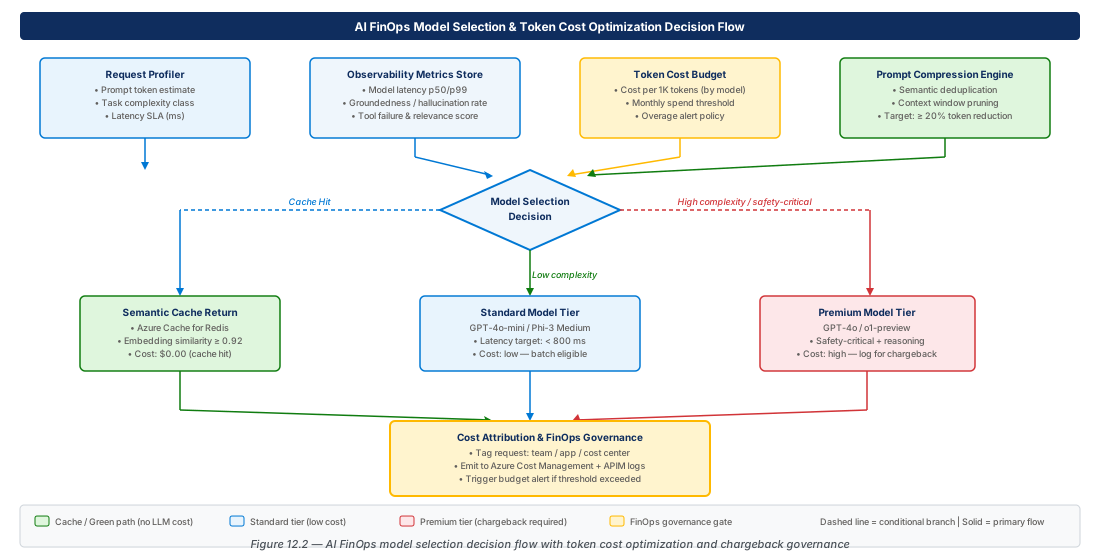
Prompt caching stores the KV cache of processed prompt prefixes server-side; requests sharing an identical prefix of at least 1,024 tokens pay the discounted cached token rate, reducing effective input costs by 50–90% for RAG applications with stable system prompts. Semantic caching operates at a higher level—Azure API Management's AI Gateway compares incoming queries to a vector index of previously answered questions and returns cached responses without invoking the LLM when similarity exceeds a configured threshold.
Prompt compression reduces input token counts via document summarization, context pruning, conversation summarization, and instruction compression. LLMLingua and similar models achieve 3–6x compression with minimal quality degradation when implemented as a middleware layer.
<policies>
  <inbound>
    <azure-openai-token-limit
      counter-key="@(context.Subscription.Id)"
      tokens-per-minute="100000"
      estimate-prompt-tokens="true" />
    <azure-openai-semantic-cache-lookup
      score-threshold="0.85"
      embeddings-backend-id="text-embedding-ada-002-backend"
      max-message-count="10" />
  </inbound>
  <outbound>
    <azure-openai-semantic-cache-store duration="3600" />
    <azure-openai-emit-token-metric namespace="AIGateway" />
  </outbound>
</policies>
Model Selection Optimization and Right-Sizing
Model selection is a FinOps decision as much as a quality decision. A task classification step at the front of the request pipeline can route simple queries to smaller models and complex reasoning tasks to larger models, reducing average cost per request by 40–70%. The model selection matrix evaluates candidates across quality, latency, cost, context window, and safety. Fine-tuned smaller models can match or exceed larger general models on narrow tasks while costing 60–80% less per token—but the FinOps calculus must include training costs, deployment hours, and the need for periodic retraining.
| Model | Input (per 1M) | Output (per 1M) | Context | Best Use Case |
|---|---|---|---|---|
| GPT-4o | $2.50 | $10.00 | 128K | Complex reasoning, multi-step tasks |
| GPT-4o mini | $0.15 | $0.60 | 128K | Classification, extraction, summarization |
| o3-mini | $1.10 | $4.40 | 200K | Mathematical, logical, code tasks |
| Phi-4 Mini (hosted) | $0.08 | $0.25 | 128K | Simple Q&A, edge scenarios |
| text-embedding-3-large | $0.13 | N/A | 8K | RAG embeddings, semantic search |
| text-embedding-3-small | $0.02 | N/A | 8K | High-volume, cost-sensitive RAG |
Tip
Implement a model routing layer in Azure API Management that evaluates query complexity using a lightweight classifier. Log routing decisions and model response quality to continuously calibrate the complexity threshold.
# Monthly budget with alerts at 80% and 100%
az consumption budget create \
  --budget-name budget-ai-prod-monthly-001 \
  --amount 15000 --time-grain Monthly \
  --start-date "2026-08-01" --end-date "2027-08-01" \
  --resource-group rg-ai-observability-finops-platform-prod-001

# Enforce cost-center tag on all Cognitive Services resources
az policy definition create \
  --name "require-ai-cost-center-tag" \
  --rules '{"if":{"allOf":[{"field":"type","contains":"Microsoft.CognitiveServices"},{"field":"tags[cost-center]","exists":"false"}]},"then":{"effect":"deny"}}' \
--mode AllWarning
PTUs are a committed spend that accrues hourly charges whether or not the deployment is receiving traffic. Purchasing PTUs without a load forecast validating sustained utilization above 70% is a common FinOps mistake that creates stranded capacity costing tens of thousands of dollars monthly.
4. Enterprise AI Reference Architecture
End-to-End Production Blueprint
The enterprise AI reference architecture synthesizes all design patterns from this book into a five-plane model. The user interaction plane handles all entry points—web chat, API clients, Teams integrations, and mobile clients—with Azure Front Door, API Management, and Microsoft Entra ID enforcing authentication at every endpoint. The AI orchestration plane hosts agents and prompt flows in Azure AI Foundry, with Azure Functions as stateless tool implementations and Service Bus decoupling long-running tasks from synchronous interfaces.
The model and skills plane provides GPT-4o, GPT-4o mini, o3, embedding, and specialized Azure AI Services behind a model routing policy in API Management. The data and knowledge plane combines Azure AI Search (vector and keyword indexes), Cosmos DB (conversation history and agent state), Data Lake Gen2 (raw document corpus), and Document Intelligence (unstructured document processing). The governance and observability plane layers Azure AI Content Safety, Key Vault, Defender for Cloud, Azure Policy, and Azure Monitor across all other planes.
Multi-Region and Disaster Recovery Patterns
Enterprise AI platforms with aggressive availability SLAs require multi-region patterns. The priority routing pattern deploys primary capacity in the home region with failover capacity in a paired region; Azure API Management health checks detect degradation and route to failover with RTO under 60 seconds. The load-balanced multi-region pattern distributes traffic across multiple regions simultaneously via Azure Front Door latency-based routing, maximizing PTU utilization and eliminating cold-start penalties.
Stateful components require special handling: Cosmos DB multi-master write with conflict resolution handles conversation history replication; Azure AI Search requires a primary index with read replicas refreshed on a schedule; Azure AI Foundry prompt flow endpoints can be deployed independently per region and registered as API Management backend pool members.
Integration with Enterprise Data and Identity Systems
Identity integration through Microsoft Entra ID enables user-context-aware responses with row-level security in Azure AI Search filtering retrieval results to documents the authenticated user is authorized to access. ERP and CRM integration via Azure Logic Apps, Power Automate, or custom Azure Functions with retry logic and circuit breakers enables agents to take actions in systems of record—but every tool that modifies enterprise system state must implement human-in-the-loop confirmation for high-impact actions.
Microsoft Purview scans the AI Search index and conversation logs to identify sensitive data exposure. Integration between Purview data classification labels and AI Content Safety policies enables dynamic content filtering based on data sensitivity—a closed-loop between data governance and AI safety controls that marks advanced enterprise AI platform maturity.
5. Production Readiness Scorecard
Security and Identity Dimensions
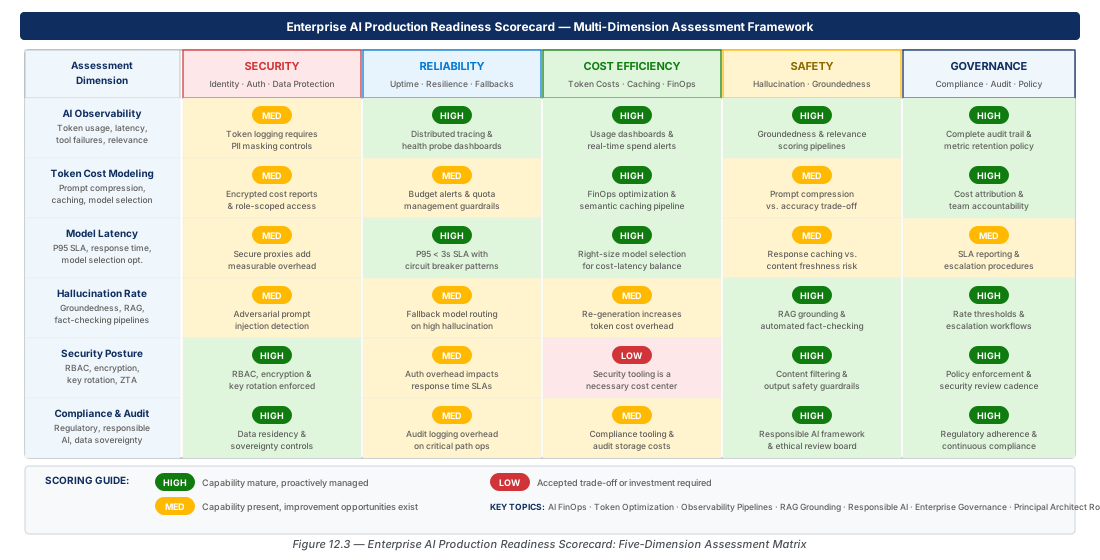
The security dimension evaluates eight controls on a 0–3 scale (0=Not Implemented, 3=Implemented and Validated). Controls cover: authentication (all endpoints require Microsoft Entra ID, no anonymous access), secrets management (all API keys in Azure Key Vault with managed identity), network isolation (all AI services on Private Endpoints), data encryption (CMK for data at rest, TLS 1.3 in transit), content safety integration, Defender for Cloud coverage, compliance policy assignments, and access auditing. A total score below 18/24 is a production deployment blocker.
Important
Microsoft Responsible AI principles require documented human oversight mechanisms for high-stakes decisions before production deployment. For regulated industries, the absence of documented oversight for use cases involving financial, medical, legal, or personnel decisions is a hard production readiness blocker.
Reliability, Cost, and Safety Dimensions
The reliability dimension evaluates availability SLA validation under peak load, circuit breaker implementation, data durability with tested backup/restore, and observability completeness across all four telemetry tiers. The cost efficiency dimension evaluates TCPC baseline establishment, Azure Cost Management budget governance, resource right-sizing, and a monthly AI cost review process. The safety dimension evaluates content safety coverage on all input/output paths, automated quality evaluation with defined hallucination rate thresholds, a documented safety incident response process, and a bias and fairness assessment with documented results.
Governance and Operational Maturity
The AI governance maturity model spans five levels: Level 1 (Ad Hoc) has no formal governance; Level 2 (Reactive) has basic Azure Policy and alerting; Level 3 (Defined) has documented policies, defined processes, and accountability—this is the minimum bar for production; Level 4 (Managed) tracks quantitative compliance metrics over time; Level 5 (Optimized) adapts governance proactively to new AI capabilities and emerging risks.
Most enterprise organizations beginning their AI platform journey operate at Level 1 or 2. Advancing to Level 4 and 5 requires sustained organizational development: AI ethics review boards, developer training on responsible AI, and embedding AI risk assessment into existing change management processes.
6. AI Architect Career Roadmap
Azure AI Certifications and Skill Progression
The Azure AI certification pathway provides structured progression from foundational to expert specialization. AI-900 (Azure AI Fundamentals) is the entry point for all technology professionals. AI-102 (Designing and Implementing a Microsoft Azure AI Solution) is the core practitioner certification validating hands-on proficiency with Azure OpenAI, AI Search, Language, Speech, Document Intelligence, and Computer Vision. The combination of AI-102 and AZ-305 represents the core certification portfolio for an Azure AI solutions architect.
| Certification | Level | Key Domains | Study Time |
|---|---|---|---|
| AI-900 | Foundational | AI concepts, Azure AI Services, Responsible AI | 20–40 hrs |
| AZ-900 | Foundational | Azure concepts, services, pricing, governance | 20–40 hrs |
| AI-102 | Associate | Azure OpenAI, AI Search, AI Services, ML Studio | 60–100 hrs |
| AZ-204 | Associate | Azure development, serverless, storage, auth | 80–120 hrs |
| AZ-305 | Expert | Solution architecture, governance, cost, DR | 80–120 hrs |
| DP-203 | Associate | Data engineering, Synapse, Databricks, pipelines | 60–100 hrs |
Emerging Skills for the Principal AI Architect
Multi-modal AI architecture—designing systems that process text, images, audio, and video through unified pipelines—is an emerging specialty as GPT-4o enables new application categories in manufacturing, healthcare, and retail. Agentic systems architecture is the most rapidly evolving frontier: principal architects who understand agent memory architectures, multi-agent coordination patterns (orchestrator-worker, peer-to-peer, hierarchical), and agent safety controls are building the capability that defines the next generation of enterprise AI.
AI FinOps specialization is an under-served discipline creating immediate career differentiation. As enterprise AI spending grows toward budget lines rivaling traditional IT infrastructure, executives demand architects who can model AI costs, optimize consumption, and demonstrate ROI using skills like TCPC modeling and PTU capacity planning.
Tip
Build a personal AI architecture portfolio by contributing to the Azure Architecture Center, publishing reference implementations on GitHub, and writing technical articles documenting real-world AI system design decisions. Architectural decision records (ADRs) capturing reasoning on hard design tradeoffs are particularly compelling portfolio artifacts.
Principal Architect Trajectory and Leadership Dimensions
The transition from senior to principal architect is fundamentally a leadership transition. Technical leadership at the principal level means setting AI architecture standards: defining the platform reference architecture, curating the approved technology portfolio, and maintaining architectural decision records. Principal architects are consulted on high-impact decisions—which AI services to standardize, whether to build or buy capabilities, and how to structure AI teams for delivery effectiveness.
Strategic engagement with AI governance, risk, and compliance (GRC) distinguishes principal architects from technical specialists. In regulated industries, principal architects translate technical AI behaviors into governance language, contribute to enterprise AI policies, participate in AI ethics review boards, and represent the architecture discipline in conversations about where and how AI should be deployed—the defining characteristic of the principal architect trajectory.
7. Lab
CE-23: Deploy AI Observability Infrastructure and Quality Evaluation Pipeline
Provision Log Analytics, Application Insights, an AI Foundry hub, an evaluation project, and metric alert rules for token consumption and error rate thresholds.
set -euo pipefail
RG="rg-ai-observability-finops-platform-prod-001"; LOC="eastus2"
LAW="law-ai-observability-prod-eastus2-001"
AHN="aihub-observability-prod-eastus2-001"

az group create --name "$RG" --location "$LOC" \
  --tags environment=prod cost-center=CC-1042

az monitor log-analytics workspace create \
  --resource-group "$RG" --workspace-name "$LAW" \
  --sku PerGB2018 --retention-time 90

LAW_ID=$(az monitor log-analytics workspace show \
  -g "$RG" -n "$LAW" --query id -o tsv)

az ml workspace create --name "$AHN" -g "$RG" \
  --kind hub --location "$LOC"
# See full script for alert rules and evaluation project setupCE-24: Implement AI FinOps Dashboard and Cost Governance Controls
Deploy Azure Cost Management budgets with alerts, apply the AI Gateway token metering and semantic caching policy, and validate FinOps tagging compliance across all AI resources.
set -euo pipefail
RG_PROD="rg-ai-observability-finops-platform-prod-001"
APIM="apim-ai-observability-prod-eastus2-001"

# Monthly budget $15K with 80%/100% alerts
az consumption budget create \
  --budget-name budget-ai-prod-monthly-001 \
  --amount 15000 --time-grain Monthly \
  --start-date "2026-08-01" --end-date "2027-08-01" \
  --resource-group "$RG_PROD"

# Validate FinOps tag compliance
az resource list -g "$RG_PROD" \
  --query "[?tags.\"cost-center\" == null].{Name:name,Type:type}" \
  --output table
# Apply APIM AI Gateway policy — see CE-24 Part A XML for full policy
8. Summary
| Concept | Key Point |
|---|---|
| AI Observability Stack | Four-tier model (infrastructure, model, quality, business) requires instrumentation beyond traditional APM; OpenTelemetry semantic conventions provide the AI telemetry standard. |
| Token Usage Monitoring | Track input, output, and cached tokens per request with contextual metadata; use Azure API Management AI Gateway for enforcement and metering at the platform layer. |
| Quality Metrics | Groundedness, relevance, and hallucination rate are semantic signals measurable via Azure AI Evaluation; track over time to detect quality drift after corpus or model updates. |
| Agent Observability | Full execution trace including all tool calls and LLM reasoning steps is required for debugging agentic failures; tool failure rate above 5% signals systemic issues. |
| AI FinOps Modeling | Total cost per conversation (TCPC) is the fundamental unit; model all cost layers including AI Search, Content Safety, and Document Intelligence—not only OpenAI token costs. |
| PTU vs PAYG Decision | PTUs are economical only above ~70% sustained utilization; validate with PAYG traffic before committing to capacity reservations to avoid stranded spend. |
| Caching and Compression | Prompt caching (50–90% input cost reduction), semantic caching (eliminates LLM calls for similar queries), and prompt compression (3–6x reduction) are complementary optimization layers. |
| Enterprise Reference Architecture | Five-plane model (user interaction, AI orchestration, model/skills, data/knowledge, governance/observability) maps every prior chapter into a unified production blueprint. |
| Production Readiness Scorecard | Security, reliability, cost efficiency, safety, and governance dimensions each scored 0–3; minimum score of 18/24 required before production deployment. |
| AI Architect Career Roadmap | AI-102 + AZ-305 form the certification core; agentic systems architecture and AI FinOps specialization are the highest-value emerging skills for the principal architect trajectory. |
Chapter: 12 of 12 | Status: v1.0 |